 Reviews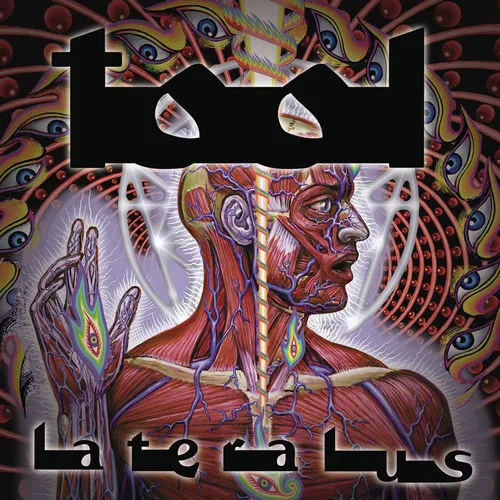
Lateralus
Tool
Lateralus uses repetition to change the listener's sense of scale, but its meticulous control becomes a limit whenever ritual replaces movement.
AI-assisted, human-reviewed
Repetition as a pressure system
“The Grudge” begins with a dry mechanical sound and a guitar figure that seems to turn over itself. The count is uneven, but the performance never asks the listener to admire arithmetic. Justin Chancellor’s bass and Adam Jones’s guitar divide the shape between them; Danny Carey identifies its stresses with kick, tom, and cymbal. The body finds the pattern before the mind finishes counting it.
That distinction is central to Lateralus. Tool uses changing meter as pressure, not decoration. A phrase ends early, an accent arrives late, or a cycle returns with one part displaced. Maynard James Keenan’s vocal often supplies the cleanest line in the arrangement. Its restraint gives the rhythm section room to make instability physical.
The closing scream in “The Grudge” lands after several minutes of limited release. Carey’s accelerating drum pattern and the band’s repeated figure narrow the space until breath becomes the only available rupture. The moment would be theatrical without that formal preparation. With it, the scream is structural.
The album’s long mechanical arc
After the short guitar transition “Eon Blue Apocalypse,” “The Patient” slows the album’s pulse without simplifying its design. Jones holds long distorted notes while bass and drums define a patient, uneven tread. Keenan’s melody nearly settles into a hymn, then adjusts its length to the measure below.
The song tests the title as behavior. Its repetitions are not identical; each return adds weight or removes support. In the final layered section, patience becomes audible effort rather than a lyric topic. Duration changes the meaning of the return.
“Mantra,” a processed sound miniature, leads into the record’s most compact statement. The interlude has sequencing value, though it also introduces a recurring weakness. Tool sometimes frames a strong piece with an object whose mystery is asserted more than developed. The album’s ritual atmosphere can make connective tissue seem more important than it sounds.
Four tests of patience and release
The Grudge: Meter becomes physical pressure
“The Grudge” turns an uneven cycle into something the body can locate. Jones and Chancellor divide the low figure between guitar and bass, while Carey identifies its stresses with kick, tom, and cymbal. Accents move, but the timbres remain distinct enough to keep the listener oriented.
Producer David Bottrill has described recording Keenan’s sustained scream in a single take. Its force on the record comes from placement rather than duration alone. The song has spent minutes rationing release while Carey’s patterns and the recurring riff narrow the available space. Breath becomes the only rupture large enough to answer the form.
Schism: Separation lives inside the riff
Chancellor’s opening bass part is recognizable through its gaps as much as its notes. Jones enters around it rather than closing those gaps, and Carey keeps changing the apparent subdivision below both instruments. The parts fit, but they never sound fully reconciled.
On “Schism,” lyric and arrangement meet with unusual economy. Keenan does not need to explain separation after the instruments have made it physical. When the bridge opens into a slower, wider pattern, the change feels like a relationship losing the effort required to stay locked together.
Lateralus: Expansion matters more than the puzzle
The grouped syllables and the 9-8-7 figure have encouraged a cottage industry of numerical explanation. Counting can describe the construction, but it does not account for the song’s effect. The important change is that each return increases the available motion: vocals lengthen the phrase, drums suggest a second grouping, and the band eventually finds a direct pulse inside the earlier instability.
At the climax, complexity produces movement rather than denser information. Bass, guitar, and drums keep changing the perceived size of one gesture. A listener can feel that expansion without solving the pattern first. The arithmetic is a tool, not the argument.
Reflection: Patience approaches ceremony
A circular Chancellor bass line and hand percussion support a gradual accumulation of guitar and voice. Carey adjusts the pattern by degrees, and Jones adds sustained color rather than an immediate riff. Because the song establishes a low event rate, each added layer changes the scale of attention.
The refusal of a conventional chorus produces hypnosis, but it also exposes the album’s limit. Once the ritual frame is secure, later returns can preserve atmosphere rather than develop it. “Reflection” stays persuasive when a new layer changes the pulse. When duration itself becomes the proof of seriousness, patience approaches ceremony for its own sake.
What precision makes physical
Carey’s drumming makes changing meter physical. He marks enough of the cycle to keep the body oriented, then shifts accents so a returning guitar figure lands differently. Chancellor and Jones often divide rather than double that figure, giving the low register more than one center of gravity.
The long forms also understand consequence. “Parabol” changes the scale of “Parabola,” and the quiet opening of “Reflection” makes a small addition feel significant. Duration matters when it changes what counts as an event.
Where control becomes insulation
The transitional pieces do not all justify the ritual importance the sequence assigns them. “Mantra” narrows attention before “Schism,” but “Faaip De Oiad” adds sampled alarm after the instrumental argument has largely ended. Mystery is sometimes asserted through placement rather than developed in the sound.
“Ticks & Leeches” has a related problem at song length. Its opening attack is precise, but the extended retreat prepares a return whose destination is already clear. Keenan’s spiritual language can also settle meanings that the instrumental relationships leave usefully unresolved.
The cycle after the final note
Lateralus changes the listener’s internal measure across most of its long duration. Repetition becomes pressure on “The Grudge,” separation on “Schism,” and altered scale in the title track. A few passages mistake sustained ceremony for further movement. The core performances avoid that trap because their complexity remains attached to breath, muscle, and the unstable agreement between four players.
Strengths and limits
Strengths
- Danny Carey's drumming makes changing meters feel bodily rather than academic.
- Long dynamic arcs produce consequences that a standard verse-chorus form could not.
Limits
- Transitional pieces sometimes inflate the album's ritual frame without adding musical argument.
- The controlled vocal and visual symbolism can close interpretation where the music remains productively open.
Sources
- Lateralus official vinyl edition and track list, Tool. Accessed July 26, 2026.
- Lateralus 2001 release listing, Tool. Accessed July 26, 2026.
- Lateralus original release, track list, and credits, MusicBrainz. Accessed July 26, 2026.
- Tool Lateralus at 25 with producer David Bottrill, Metal Hammer. Accessed July 26, 2026.
Album artwork remains the property of its respective rights holders. It is reproduced at limited resolution on this review page for identification and critical context.