 Reviews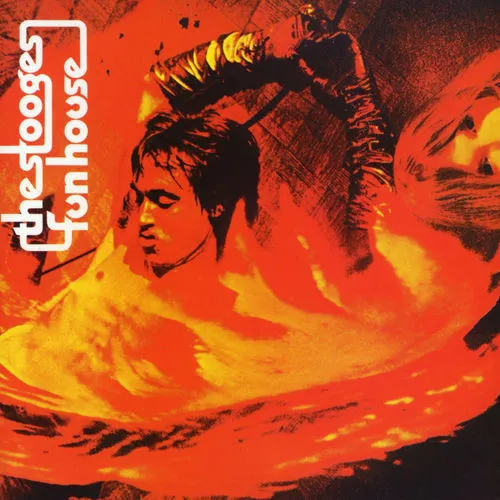
Fun House
The Stooges
Fun House organizes its apparent collapse: short songs establish the room, repetition changes the air, and saxophone arrives only after the band has made chaos legible.
AI-assisted, human-reviewed
A studio that behaves like a stage
Fun House arrived in July 1970 as the Stooges’ second album. Producer Don Gallucci had seen the band live and tried to preserve that force at Elektra Sound Recorders in Los Angeles. Rhino’s archive of the sessions shows the method: the band played live in the studio, repeating one song through numerous takes before moving to the next. Seven performances were selected and ordered into the final album.
The sessions contradict the idea that the record is primitive noise. Fun House does not gain force from musicians losing control by accident. Control is redistributed over the sequence. Short songs establish pulse and instrumental separation; longer tracks let repetition alter the room; the finale removes the stable groove that made the earlier disorder readable.
The usual proto-punk label also hides part of the music. Blues repetition, R&B drive, and Steve Mackay’s saxophone are central to the album’s motion. They are not refinements added to an otherwise blunt rock attack. Dave Alexander and Scott Asheton make those sources audible in the swing and elasticity beneath Ron Asheton’s distortion.
Seven takes, rising heat
“Down on the Street” and “Loose” are compact because the album needs a clear room before it can damage it. Ron Asheton’s guitar riffs are blunt but not shapeless. Dave Alexander’s bass moves beneath them with more elasticity than the band’s reputation for minimalism implies. Scott Asheton’s drumming is direct, yet the placement of fills and cymbal openings gives repetition a forward lean.
Iggy Pop sings in short commands and exposed vowels. He does not narrate a detailed scene. The voice establishes temperature and proximity. On “Loose,” the band sounds close enough that each small acceleration changes the apparent size of the room.
“T.V. Eye” intensifies that system. The opening cry feels unmediated, but the track beneath it is sharply organized. Guitar and bass hold a repeating figure while drums keep adjusting the push. The vocal is free to sound dangerous because the ensemble is not falling apart.
What has aged here is not the playing. It is some of the mythology attached to male transgression as authenticity. The performance remains compelling; the idea that danger alone certifies artistic truth is less useful. The musical decisions carry more weight than that frame.
Where control starts to slip
Down on the Street: The room before the collapse
Rhino’s session archive documents that the band recorded live in the studio over several days, repeating songs in pursuit of its concert sound. “Down on the Street” reveals why that method mattered. Ron Asheton’s clipped guitar, Dave Alexander’s moving bass, and Scott Asheton’s unhurried beat remain separately readable even when the performance runs hot.
Iggy Pop works with repeated phrases and exposed vowels rather than a developed narrative. The voice sets proximity and temperature. Small changes in Alexander’s bass and Scott’s cymbal placement therefore register as real movement. The album needs this compact, disciplined room before later tracks can damage it.
Dirt: Repetition slows perception
“Dirt” stretches one condition across seven minutes. Ron’s guitar scratches and bends inside the groove instead of escaping into a separate solo space. Alexander holds a low, elastic center, while Scott leaves enough air around the beat for each vocal entrance to feel risky.
The song develops through timbre, pressure, and placement rather than new sections. Its length is demanding, but the rhythm keeps it from becoming shapeless. Aggression no longer means speed or immediate collision. It means making the listener inhabit a pulse until small differences become unavoidable.
Fun House: Disorder remains measurable
Steve Mackay’s saxophone enters an ensemble that has spent five tracks establishing how repetition works. On the title track, saxophone and guitar crowd the upper register while bass and drums preserve a danceable center. Every squeal and vocal eruption has something firm to push against.
The freedom stays controlled. The recording keeps the harsh guitar from covering Alexander, and the drums remain present without becoming oversized. Mackay can pull against the groove because the rhythm section never stops making the groove legible.
L.A. Blues: The method consumes the song
The closer removes that center. Saxophone, guitar, drums, and voice collide without the stable pulse that protected the title track. As a standalone piece, it offers little development; force accumulates, but the relationships between sounds do not keep changing.
Its sequence position gives the noise meaning. The album has moved from compact songs through stretched repetition to a room that can no longer contain the band. On repeated listening, the line between a deliberate terminal state and undifferentiated noise remains unresolved. A controlled recovery would betray the design, but collapse is less interesting than the discipline that made it possible.
The discipline inside the noise
The sequence changes the definition of control without losing the sound of musicians responding in one room. Alexander and Scott Asheton make repetition swing; Ron Asheton can use distortion as rhythm because the bass remains audible beneath it. When Mackay enters, he disrupts a system the listener already understands.
Gallucci’s live-in-the-studio method preserves that relationship. The recording is harsh without becoming a blur. Drums do not acquire artificial size, and the upper-register collision of voice, guitar, and saxophone never fully erases the groove.
When the method consumes the song
“L.A. Blues” is more persuasive as a terminal condition than as a composition. Once the steady pulse disappears, force accumulates without the small rhythmic differences that make “Dirt” and “Fun House” develop across comparable durations.
Later punk mythology creates another distortion. Calling the album an origin point can make its roughness sound self-generated and conceal the blues and R&B mechanics underneath. The sparse lyrics have also aged unevenly: Iggy’s phrasing remains distinctive, while provocation alone carries less meaning than it once did.
No clean exit
Fun House comes apart in a specific order. Compact songs establish instrumental separation, “Dirt” slows the listener’s scale of attention, and the title track admits saxophone without surrendering pulse. Those earlier performances define what the final collapse loses. Disciplined rhythm makes the disorder legible.
Strengths and limits
Strengths
- The sequence moves from compact song form to open collapse without losing ensemble logic.
- Dave Alexander and Scott Asheton make repetition swing instead of merely bludgeon.
Limits
- L.A. Blues is more convincing as a terminal state than as a piece with internal development.
- The album's later punk mythology can obscure how deeply its movement depends on blues and R&B.
Sources
- Fun House release group and editions, MusicBrainz. Accessed August 7, 2026.
- Building Fun House, Iggy and the Stooges. Accessed August 7, 2026.
- The Stooges' Fun House with Ron Asheton and Don Gallucci, Sound Opinions. Accessed August 7, 2026.
- The Complete Funhouse Sessions recording notes, Rhino. Accessed July 26, 2026.
Album artwork remains the property of its respective rights holders. It is reproduced at limited resolution on this review page for identification and critical context.