 Reviews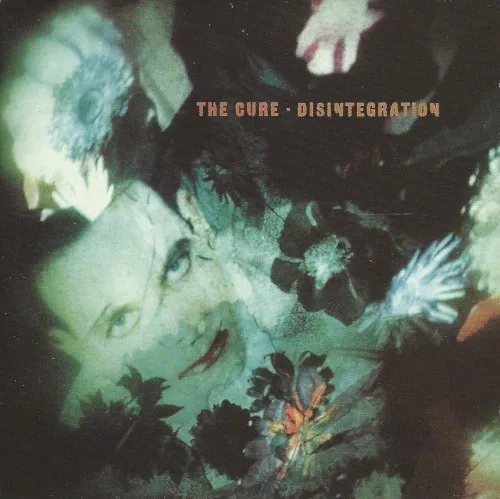
Full Review
AI-assisted, human-reviewed
Disintegration
The Cure
Disintegration lets musical events linger: long introductions, repeated figures, and slow decays make time itself carry the album's grief.
Time becomes the subject
The first drum hit on Disintegration arrives after the atmosphere is already in place. “Plainsong” begins with small metallic sounds, then a keyboard swell fills the stereo field. Guitar and bass enter as parts of that weather rather than as a band announcing a song. Robert Smith waits before singing. By then, the arrangement has established a world in which every event seems to leave a long afterimage.
The Cure builds each song through patience. Introductions run, figures repeat after their outlines are clear, and notes decay into the next layer. The songs concern memory, aging, attachment, fear, and separation, but the record does not depend on lyrical confession alone. Duration changes how the material is felt. A melody that initially offers orientation can become a reminder that the song has not found an exit.
Mood is only part of Disintegration’s darkness. It also has a mechanism. Simon Gallup’s bass and Boris Williams’s drums create steady forward motion while guitars and keyboards make the surrounding space feel almost still. The listener moves through an environment that appears reluctant to change. Time is not the container for the songs. It is one of their instruments.
A band building weather
The Cure released Disintegration on Fiction on May 2, 1989. The band’s official archive credits Robert Smith and David M. Allen as producers and lists Hookend Recording Studios in Oxfordshire as the recording location. The twelve-song sequence runs well beyond an hour. Its scale followed the brighter and more varied Kiss Me Kiss Me Kiss Me, yet the sound is not a simple retreat from pop. “Lovesong,” “Lullaby,” and “Fascination Street” retain concise hooks inside the larger design.
Smith, Gallup, Williams, Porl Thompson, and Roger O’Donnell supply most of the audible architecture. Lol Tolhurst is credited as a performer, though his role in the sessions was limited. Gallup’s bass often provides the clearest melodic object in the lower register. Williams plays with firmness but little display, allowing long songs to move without sounding hurried. O’Donnell’s keyboards widen the harmonic field, while Smith and Thompson layer guitar lines that can be difficult to separate yet easy to feel as depth.
The production places those parts in planes. A bass figure may sit close and dry while a guitar appears farther away under modulation; keyboards can occupy the whole horizon without erasing the drum pulse. Smith’s voice usually enters after the instrumental relationships are secure. The songs therefore begin as places before they become statements.
Four ways to inhabit the duration
Plainsong: The entrance is already a memory
The opening keyboard mass arrives with enough force to resemble a climax, but the song does not resolve from it. Gallup’s bass outlines a patient descent. Williams spaces his snare hits widely, and a high guitar line flashes through the sustained harmony. The arrangement is large without becoming busy.
When Smith finally sings, his voice is lower and more contained than the surrounding sound. That difference matters. The music seems to exceed the person describing it, as though the scene has already outlasted the encounter at its center. “Plainsong” makes the album’s scale credible because it uses size to create distance, not grandeur.
Pictures of You: Repetition changes the evidence
“Pictures of You” spends a long time assembling itself. Drums establish an even pace; bass supplies a memorable turning figure; several guitar lines enter at different depths. None of these parts is harmonically complicated. Their placement and recurrence do the work.
The extended introduction makes the vocal feel like a response to evidence already laid out. As the same instrumental shapes return, they acquire the persistence of objects handled too often. The song does not need a dramatic key change to intensify. Smith sings with greater strain, while the band continues to circle material that was present from the start. Memory alters the meaning of repetition even when the notes remain stable.
Fascination Street: The body enters the atmosphere
Gallup’s bass leads “Fascination Street” with a descending figure that is more assertive than most of the album’s foundations. Williams answers with a straight, danceable pulse. Guitar noise and keyboards still create depth, but the rhythm section pulls the song toward the body rather than allowing it to hover.
That physical clarity gives the sequence necessary contrast. The track remains nocturnal without becoming vaporous. Smith’s vocal sits inside a groove that can proceed without him, and the instrumental passages gain tension from withholding a larger release. The A firm rhythmic floor makes the atmosphere more convincing.
The Same Deep Water as You: Slowness tests its limit
Rain and distant weather frame “The Same Deep Water as You.” The band settles into a slow compound pulse, with Williams marking broad cycles and Gallup giving each return a low, measured contour. Guitar lines drift above that foundation without sharpening into a conventional lead.
Across more than nine minutes, small changes in density carry unusual weight. Smith can hold a phrase across the pulse because the arrangement has made space around him. The effect is immersive, but the duration also approaches self-enclosure. Once the song has established its depth and pace, later returns intensify the condition more than they develop it. The track is the album’s method at its most complete and its most demanding.
What the long forms reveal
The album’s length permits instrumental information to arrive before explanation. “Closedown” lets percussion and keyboards establish unease before the vocal names exhaustion. “Prayers for Rain” builds pressure through the narrowing of its repeated figure, not through a quick chorus. The title track sustains a fast, insistent pulse while Smith’s delivery grows less composed, making emotional collapse occur against a band that refuses to collapse with him.
Gallup and Williams are essential to that design. Their parts keep the record from mistaking suspension for stasis. Bass melodies offer routes through the mixes; drums make the long decays measurable. “Lovesong” compresses the system into a miniature. Its direct bass movement, compact form, and comparatively plain vocal do not break the album’s atmosphere. They reveal how much of that atmosphere survives without an extended introduction.
When the weather stops changing
The consistency has a cumulative cost. Similar keyboard veils, moderate or slow tempos, and long instrumental thresholds recur across the sequence. On individual songs, those choices create proportion. Heard across all twelve, they can reduce the shock of a new entrance. The album sometimes asks texture to provide a contrast that tempo and form do not.
The final stretch is especially exacting. “The Same Deep Water as You,” the title track, “Homesick,” and “Untitled” occupy a large block of time with few uncomplicated releases. Each has its own rhythmic and melodic identity, but all delay closure. “Homesick” develops an affecting piano-centered space; by the time it arrives, the gesture of gradual accumulation is familiar. “Untitled” benefits from sounding smaller and more exposed, yet it inherits some fatigue from everything the sequence refuses to discharge.
The record’s scale creates its best effects. Its limit appears when duration stops changing the meaning of a figure and merely extends a condition the listener already understands.
The sound remains after the event
Disintegration uses time to make grief audible as persistence. Its introductions allow places to form before Smith enters them. Its repetitions let melodies move from guidance to burden. Gallup and Williams keep those slow transformations physical, while the guitars and keyboards blur the boundary between a note and its residue.
The method can seal the sequence too tightly, particularly when the late songs keep delaying exits that no longer seem possible. Yet that excess belongs to the album’s argument. Events end cleanly; memory does not. Disintegration gives the remaining sound enough time to become the main event.
The argument
Strengths and limits
Strengths
- Long introductions let rhythm and texture establish emotional conditions before words.
- Simon Gallup and Boris Williams give the dense arrangements a clear physical motion.
Limits
- Similar tempos and recurring keyboard veils can flatten contrast across the full runtime.
- Several late songs delay resolution after their emotional terms are already established.
Further reading: Disintegration on The Cure's official site
Documentation
Sources
- Disintegration release details and original track list, The Cure. Accessed August 1, 2026.
- Disintegration deluxe edition release notes, Rhino. Accessed August 1, 2026.
- Disintegration, a 1989 interview with Robert Smith, The Quietus. Accessed August 1, 2026.
- Disintegration release, credits, and track durations, MusicBrainz. Accessed August 1, 2026.
Album artwork remains the property of its respective rights holders. It is reproduced at limited resolution on this review page for identification and critical context.