 Reviews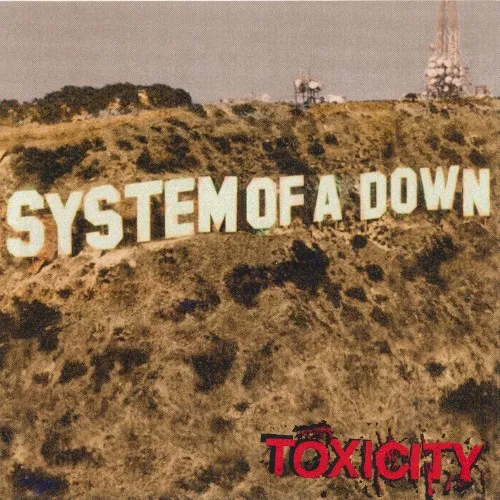
Full Review
AI-assisted, human-reviewed
Toxicity
System of a Down
Toxicity treats its violent stylistic turns as acts of compression: exact drums, short sections, and divided vocals make crowded songs legible without making them simple.
Too many ideas, precisely placed
“Prison Song” begins with a full-band blow, stops, and starts again as if testing the listener’s reflexes. Serj Tankian enters over a clipped guitar pattern; John Dolmayan’s drums turn the riff into a march, then push it toward hardcore. A slower chant appears without warning. None of these sections lasts long enough to become the song’s stable identity.
That density is the organizing fact of Toxicity. System of a Down compress political argument, slapstick, folk-inflected melody, thrash attack, and arena-scale choruses into forty-four minutes. The songs often resemble collisions, but their timing is exact. Dolmayan marks the hinge; Shavo Odadjian keeps the low end uncluttered; Daron Malakian’s guitar changes function quickly; Tankian and Malakian divide information between voices.
System of a Down makes that crowded range legible without slowing down to explain the joins.
Thirty songs narrowed to one record
System of a Down made their second album after the long touring cycle for their 1998 debut. The group recorded more material than the standard release could hold; fifteen tracks appear on the familiar edition, while further songs from the sessions later formed much of Steal This Album!. Rick Rubin and Malakian produced Toxicity, Tankian served as co-producer, and Andy Wallace mixed it.
The working division is audible. Malakian’s guitar often avoids a continuous wall of distortion. He uses dry single-note figures, tremolo-like picking, broad muted chords, and small clean shapes that leave Tankian’s consonants exposed. Odadjian’s bass reinforces the riff without crowding it. Dolmayan can follow a vocal accent, announce a new meter, or make silence part of the groove. The mix gives each transition a sharp edge.
Tankian and Malakian do not operate as lead singer and decorative backing voice. Their contrasting registers let a song change speaker without adding another verse. Tankian can move from measured declamation to elastic high notes; Malakian supplies a thinner, plaintive line or a hard group response. Vocal arrangement becomes a form of editing.
Three arguments under pressure
Prison Song: The list becomes percussion
“Prison Song” carries a large political subject: incarceration, drug policy, and the economic interests attached to both. The lyric alternates compressed statistics and claims with shouted responses. Tankian delivers much of it in a narrow, speech-like register, treating syllables as part of the rhythm section rather than stretching them into melody.
The band prevents the informational load from becoming a lecture by changing the body under it. Dolmayan moves between stabbing accents and a steadier drive; Malakian cuts the guitar away and returns with heavier blocks. The arrangement clarifies changes in argument through changes in pulse. It cannot prove every claim it contains, but it makes the pressure of accumulation audible.
Chop Suey!: A chorus assembled from disagreement
The opening strummed figure of “Chop Suey!” is bright and quick. A sudden heavy passage breaks it apart, Tankian rushes through the verse, and the band repeatedly removes the floor beneath him. The chorus keeps these materials apart: Malakian’s higher response and Tankian’s lead overlap like incompatible accounts of the same event.
Late in the song, Dolmayan opens the beat and the voices lengthen their phrases. Piano and guitar widen the harmony while Tankian’s delivery moves from accusation toward lament. After so much compression, a song built from interruption finds its largest emotion only when it permits a line to continue.
Toxicity: The drums explain the turn
The title track places a light, circling guitar figure beside a verse groove shaped by Dolmayan’s toms and displaced accents. Tankian sings with unusual patience, leaving room between images. The chorus then converts that space into a broad downward guitar movement and a sustained vocal line.
The transition could sound arbitrary. Dolmayan makes it inevitable by treating the fills as syntax: each one closes a phrase and identifies the weight of the next. When the final section accelerates, the drums preserve the song’s outline even as guitar and voice become more frantic. Precision does not restrain the disorder; it lets the disorder communicate.
Rhythm makes fragmentation memorable
Dolmayan is the album’s clearest editor. His parts are active but rarely vague. Cymbal chokes create commas, snare accents underline vocal stress, and tom patterns announce a change before the guitar fully arrives. This makes short tracks such as “Jet Pilot” and “X” feel composed rather than merely hurried. The listener may not predict the next section, but can recognize the instant it begins.
The two singers add another layer of economy. On “Needles,” Malakian’s responses make the hook sound communal and argumentative at once. “Aerials” uses the contrast more slowly: Tankian carries the verse in a rounded, controlled register while Malakian’s supporting voice thickens the refrain. The album can therefore move between satire, warning, and lament without asking one vocal persona to contain all three.
Its melodic writing is equally important. Armenian-inflected turns in phrasing and guitar melody sit beside punk brevity and metal weight. The record does not pause to label those sources. It uses them as working parts of songs whose hooks remain clear even when their structures refuse a standard verse-chorus balance.
Compression can flatten an argument
The same brevity that gives Toxicity its momentum sometimes leaves a song at the level of premise. “Bounce” has a sharply coordinated vocal and rhythmic joke, but repetition does more to confirm the joke than to alter it. “Shimmy” races through its critique with conviction; its compact form leaves little space to distinguish slogan from observation.
Political compression creates a more serious problem. “Prison Song” gains force from stacking claims, yet the arrangement moves too quickly for the listener to inspect their different scales or contexts. The song communicates systemic pressure more successfully than it builds a careful case. Elsewhere, surreal images can productively resist a single reading, but they can also place distance between a concrete subject and its consequences.
The crowded sequence amplifies this unevenness. With fifteen tracks in forty-four minutes, a weaker idea disappears quickly, but a strong one may also be denied the development it deserves.
Disorder reduced to essentials
Toxicity sounds volatile because it preserves disagreement: heavy and delicate parts, satire and grief, Tankian’s authority and Malakian’s dissenting edge. It holds together because the band reduces every change to a clear event. A drum fill, a stopped guitar, or a second voice can reorganize a song in seconds.
That compression has limits. Some arguments become slogans, and some compact tracks are finished before their premise has changed. “Chop Suey!” uses brevity to expose connections that a smoother arrangement would hide; it needs its fractures for the final lament to carry weight; “Toxicity” needs rhythmic exactness for frenzy to remain readable.
The album’s apparent excess is built from restraint. System of a Down keep only the decisive gesture, place it hard against the next one, and trust rhythm to explain the collision.
The argument
Strengths and limits
Strengths
- John Dolmayan's drumming makes abrupt changes in meter, tempo, and weight immediately legible.
- Serj Tankian and Daron Malakian turn vocal contrast into a compact arranging tool.
Limits
- Several brief songs substitute a striking premise for sustained musical development.
- The dense sequence gives some political claims too little room to become precise.
Further reading: Toxicity release group and editions
Documentation
Sources
- Toxicity track list and full album credits, System of a Down. Accessed July 31, 2026.
- Toxicity original release and track list, MusicBrainz. Accessed July 31, 2026.
- Toxicity digital album and credits, Qobuz. Accessed July 31, 2026.
- The explosive story behind System of a Down's Toxicity album, Metal Hammer. Accessed July 31, 2026.
Album artwork remains the property of its respective rights holders. It is reproduced at limited resolution on this review page for identification and critical context.