 Reviews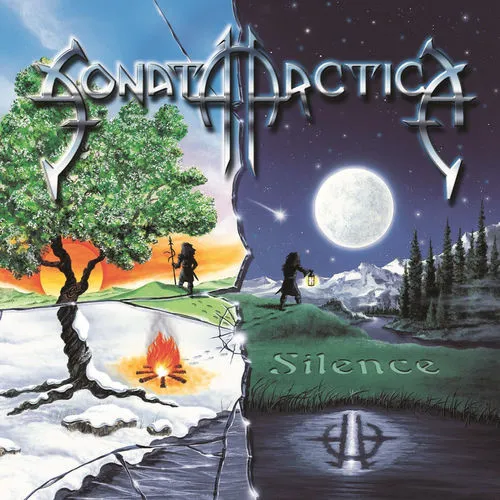
Full Review
AI-assisted, human-reviewed
Silence
Sonata Arctica
On Silence, speed often sounds like emotional avoidance; bright melodies expose lonely and unstable narrators, even when the album's abundance weakens its final shape.
Speed cannot hide the loneliness
After the brief spoken threshold of “…Of Silence,” “Weballergy” arrives with drums and keyboards already in motion. The performance is bright, clean, and almost impatient. Tony Kakko’s vocal melody rises easily above it, but the ease is deceptive. Across Silence, movement repeatedly belongs to people who cannot sit with what they have done or lost.
That tension gives Sonata Arctica’s second album more character than a display of early power-metal fluency would provide. Kakko writes hooks with the speed and clarity the style demands, then fills them with jealousy, separation, wounded pride, and unstable attachment. The music opens outward while the narrators turn inward. Even the title suggests an absence that the arrangements spend an hour trying to cover.
The album does not maintain that tension equally well. Some songs use velocity to expose a character; others simply repeat a successful combination of double-kick drums, keyboard figures, and a rising chorus. Its ballads can interrupt the rush with real vulnerability, but their placement also makes the sequence feel crowded. Silence has a strong emotional language and more material than that language always needs.
A bright surface, a darker script
Kakko wrote every song, and Sonata Arctica arranged them as a band. The record was tracked at Tico Tico Studio during fall 2000 and spring 2001, mixed by Mikko Karmila at Finnvox in April, and mastered there by Mika Jussila. That chain produces a crisp, forward sound. Tommy Portimo’s kick drum remains distinct at high speed, Mikko Härkin’s keyboards occupy a bright upper register, and Jani Liimatainen’s guitar keeps enough edge to prevent the melodies from becoming weightless.
The lineup had also become more clearly defined after Ecliptica. Marko Paasikoski’s bass supports rapid harmonic movement without demanding attention, while Kakko adds keyboards alongside his lead vocal. The arrangements often pass a melodic cell between keyboard and guitar. Sometimes they double each other; elsewhere one holds a chordal bed while the other takes the moving line. The songs stay coordinated when each instrument has a distinct role.
The 13-track standard edition alternates speed, mid-tempo drama, instrumentals, and piano- led ballads. “Revontulet” works as a short instrumental reset before “Tallulah.” The closing “The Power of One” then stretches beyond eleven minutes, including silence and a spoken outtake. Its scale announces ambition, although the album has already made most of its argument in shorter forms.
Narratively, Silence is less unified than a concept album but more connected than a collection of unrelated genre exercises. Kakko returns to people who mistake possession for love or turn hurt into performance. The songs do not always criticize those speakers with equal clarity. Their recurring loneliness is nevertheless audible in the gap between buoyant arrangements and anxious words.
Four songs, four kinds of distance
Weballergy: Flight begins before reflection
“Weballergy” is built for immediate acceleration. Portimo’s drums establish the fast floor, keyboard and guitar figures move in compact parallel lines, and Kakko places a smooth melody above the activity. The chorus broadens the harmony without slowing the song, so release arrives as another form of motion.
The performance makes restlessness attractive. That attraction is part of the song’s meaning, since the narrator keeps defining freedom as departure. The band does not insert a heavy breakdown or dramatic pause to expose the contradiction. It lets the polished forward drive carry the unease.
The End of This Chapter: Melodrama enters dangerous territory
Grand piano and spoken voices give “The End of This Chapter” a staged intimacy. Kakko begins in a controlled register, leaving space around the words before the band increases pressure. As the arrangement expands, the narrator’s fixation stops sounding like private hurt and becomes a threat.
The seven-minute form gives that change time. Piano returns as a memory of tenderness while heavier sections reveal coercion underneath it. The song’s problem is also its subject: the arrangement can make obsession sound grand enough to risk flattering it. The female and male spoken roles establish distance from the narrator, but the towering chorus still centers his pain. Sonata Arctica makes his instability audible without fully settling how much sympathy he deserves.
Tallulah: A ballad refuses the protective rush
“Tallulah” removes the rapid rhythmic cover. Piano carries the harmonic outline, and Kakko sings closer to conversational pace. When the band enters, it supports the melody instead of converting the song into a late power-metal climax. The restraint allows small changes in his delivery to matter.
The song is direct to the point of discomfort. Its remembered details and repeated name do not hide behind fantasy or speed. That plainness distinguishes it from the album’s more elaborate character scenes. It also reveals a limit in Kakko’s romantic writing: regret can slide toward self-absorption when the absent person has little space of her own.
Wolf & Raven: Technique becomes panic
“Wolf & Raven” brings the fast vocabulary back in its most compressed form. Portimo’s double-kick pattern, Liimatainen’s precise attack, and Härkin’s upper-register lines leave few empty beats. Kakko responds with short, urgent phrases before the chorus stretches the melody over the same pressure.
Here virtuosity has a dramatic purpose. The song’s speed sounds hunted rather than carefree, and the tight unison passages make the band resemble one nervous mechanism. A slower arrangement would turn its conflict into solemn fantasy. At this pace, divided identity becomes physical strain.
Melody as dramatic memory
Several of Kakko’s melodies do more than identify a chorus. They retain the emotional shape of the verse and return it in a form the listener can remember. “Last Drop Falls” uses that gift at mid-tempo, while “San Sebastian (Revisited)” lets a bright refrain carry the ache of missed timing. The hooks simplify the surface without simplifying the speaker.
The keyboard and guitar partnership is equally important. Härkin gives the album much of its color, but Liimatainen keeps the sound grounded through attack and rhythmic definition. Their lines can be ornate, yet the arrangements usually know which instrument should lead. Karmila’s mix preserves that division at speeds that could easily turn the upper register into glare.
The band also moves between forms without losing its identity. Piano ballads, a short instrumental, direct speed-metal songs, and the closing epic share Kakko’s melodic habits. That continuity makes Silence feel authored rather than assembled from genre requirements.
Where abundance weakens selection
The album repeats its central contrast often enough to reduce surprise. A fast song followed by a wounded mid-tempo piece or ballad remains effective, but each return asks less of the ear. “Sing in Silence” and “Last Drop Falls” contain distinct melodies; in the full sequence, their emotional pace can blur.
“The Power of One” poses a larger structural question. Its long form moves through several levels of intensity and gives the band room to revisit ideas. The duration itself does not produce a deeper argument than the shorter songs, and the hidden silence plus outtake loosens the ending. Ambition replaces selection at the moment the record most needs a decisive close.
The lyrics also depend heavily on first-person grievance. Kakko varies the circumstances, but women too often appear as absent causes of male pain rather than equally present characters. “The End of This Chapter” recognizes the danger more clearly than some of the romantic songs around it. The album’s emotional honesty is real; its point of view is narrower than its melodic range.
Silence after the sprint
Silence lives on friction. The arrangements promise lift, while the voices keep returning to isolation and poor choices. Speed can sound like denial, and a clear chorus can preserve the bruise carried into it. The record loses shape when every strong melodic idea is granted equal space. Its tension lies between those crowded surfaces and the quiet its narrators cannot tolerate.
The argument
Strengths and limits
Strengths
- Tony Kakko writes vocal melodies that retain character inside very fast arrangements.
- Keyboards and guitar share melodic work without turning every song into a solo contest.
Limits
- The sequence repeats ballad and high-speed contrasts without always changing their effect.
- The long closing track adds scale after the album's emotional vocabulary is already clear.
Documentation
Sources
- Silence tracklist, credits, and recording information, Sonata Arctica. Accessed July 26, 2026.
- Silence release group and editions, MusicBrainz. Accessed July 26, 2026.
- Silence Finnish release, track lengths, and credits, MusicBrainz. Accessed July 26, 2026.
- Sonata Arctica Silence review, Metal Reviews. Accessed July 26, 2026.
Album artwork remains the property of its respective rights holders. It is reproduced at limited resolution on this review page for identification and critical context.