 Reviews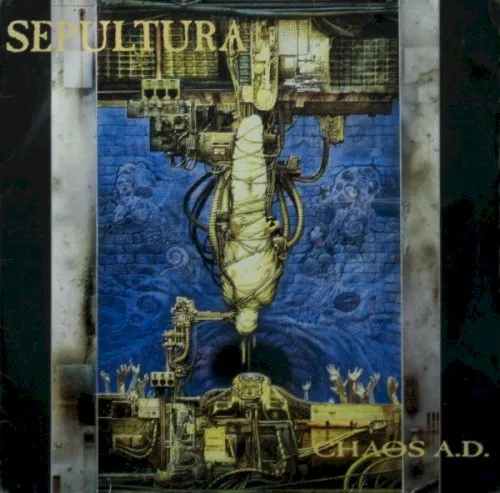
Full Review
AI-assisted, human-reviewed
Chaos A.D.
Sepultura
Chaos A.D. gains force by reducing speed and exposing the beat: its simpler structures turn resistance from lyrical subject into a bodily, collective action.
The first downbeat changes the band
The opening of “Refuse/Resist” contains the argument of Chaos A.D. in miniature. A heartbeat and street noise give way to Igor Cavalera’s drums, then the band lands on a riff with enough space around it for every strike to register. Earlier Sepultura records proved how violently the group could accelerate. Here, slowing down makes the music feel larger and more public.
That change is not retreat. Max Cavalera’s short vocal lines, Andreas Kisser’s sharply bounded guitar figures, Paulo Jr.’s bass, and Igor’s displaced accents turn the beat into a point of assembly. Political resistance is carried as much by shared timing as by words.
The move is especially striking after Beneath the Remains and Arise, albums whose precision made acceleration a measure of authority. On Chaos A.D., the band no longer needs to fill every subdivision to prove command. A rest can become a threat; a repeated two-note figure can hold more tension than a long chromatic run. Sepultura does not become less technical. It relocates technique from the number of events to the weight and placement of each one.
Weight after speed
Sepultura recorded with producer Andy Wallace after the technical extremity of Arise. The twelve-track standard edition keeps thrash metal’s attack but loosens its constant forward drive. Riffs repeat long enough to become physical instructions. Cymbals and toms occupy a wider field, while the guitar often functions as percussion with pitch rather than an unbroken wall.
The production gives simplicity consequences. When the band changes one accent or removes the guitar, the listener feels the floor shift. On Chaos A.D., groove is less a style label than a way of making conflict legible.
Wallace keeps the low end firm without letting it blur the pick attack. Kisser’s guitar often has a dry, serrated edge, while Igor’s toms carry more resonance and apparent depth. That separation matters on “Amen”: an opening guitar figure suspends the pulse before the full band turns it into a heavy procession. The song can move from ominous space to massed impact because the record has not spent all of its volume in advance.
Rhythm as public speech
Refuse/Resist: The snare starts a march
Igor’s opening pattern refuses a square rock backbeat. Toms roll beneath the central riff, and the snare places hard interruptions against it. Max answers in phrases short enough to sound collective even when one person shouts them. The chorus does not explain resistance; its paired verbs create a rhythm anyone could return. The song’s economy is the source of its scale.
Territory: Space between the blows
“Territory” opens with a dry guitar figure and drums that imply several possible downbeats before the full riff settles. The main pattern is simple, but its rests matter as much as its notes. Those gaps let Igor’s kick and snare argue with the guitar rather than merely support it. Max’s vocal sits above the riff like a warning issued across distance. The arrangement turns geopolitical division into repeated musical borders: stop, strike, withdraw, return.
Slave New World: Compression without blur
At under three minutes, “Slave New World” restores speed without returning to the older band’s density. The verse riff stays clipped, the drums remain readable, and the chorus widens instead of adding more notes. The track demonstrates what Sepultura learned from reduction. Fast music can still leave distinct edges, allowing anger to arrive as a series of decisions rather than one continuous rush.
Elsewhere, the band tests how much variation that new grammar can hold. “Propaganda” uses a more nervous, forward-driving figure, then opens holes around Max’s vocal instead of settling into a broad chant. “We Who Are Not as Others” does the opposite: its deliberate repetition turns refusal into endurance. These tracks are not interchangeable examples of groove. One keeps trying to escape its bar; the other makes remaining in place the point.
Kaiowas opens the circle
The acoustic “Kaiowas,” recorded at Chepstow Castle, is not an interlude that suspends the album’s force. Layered hand percussion and acoustic guitars move emphasis among the players; no distorted riff is needed to organise attention. Its circular construction replaces the front-facing command of the electric songs with group motion.
The recording’s open air is audible in its looser boundary. Hands, strings, and drum skins do not arrive with the close, hard outline of the studio tracks. The players pass a pulse rather than doubling one another, and the accelerating final passage grows through participation instead of amplification. Here, collective weight does not require uniformity.
That shift matters because Chaos A.D. is interested in more than individual fury. “We Who Are Not as Others” builds identity through stubborn repetition, while the New Model Army cover “The Hunt” lets the band test its weight against a song not written in metal’s vocabulary. Different materials enter the record, but rhythm keeps them in the same argument.
When directness becomes a slogan
The album’s compression sometimes reduces thought as well as music. “Biotech Is Godzilla” is a furious miniature aimed at corporate and political power, but its caricature offers little room for the institutional complexity behind the anger. “Manifest,” built around the Carandiru prison massacre, draws moral force from specificity, yet its documentary framing and blunt refrain do not develop the event beyond indictment.
Later tracks also confirm more often than surprise. “Nomad” and “Clenched Fist” have powerful low-slung figures, but by the close their method is familiar: isolate the riff, enlarge the drum pattern, make the chorus a communal blow. Consistency gives the album identity while narrowing its second-half dramatic range.
“The Hunt” presents a different problem. Sepultura thickens New Model Army’s post-punk song effectively, but the adaptation is so compatible with the surrounding record that it loses some of the friction a cover can create. Its direct pulse and compact refrain fit the new Sepultura almost too neatly. By contrast, “Kaiowas” changes the album’s terms rather than merely proving that another song can survive them.
The beat remains contested ground
Chaos A.D. changed Sepultura by asking what heaviness could do once speed stopped being its main proof. The answer is audible in the space between guitar strokes, in Igor Cavalera’s ability to redirect a riff from below, and in vocals shaped for collective recall.
The album also changes the scale at which a metal band can sound political. Its message does not simply sit on top of an otherwise neutral attack. “Territory” makes division audible in its stops and contested accents; “Refuse/Resist” builds assembly into the relationship between drums and voice. The rhythms communicate before every reference is known, but knowing the references does not exhaust what they say.
Its politics are strongest when embedded in those relationships. Musicians listen, answer, and align without becoming identical. The weaker slogans show the limit of compression; the best grooves show its democratic possibility. Sepultura made fewer notes carry more bodies, and turned the downbeat into contested ground.
The argument
Strengths and limits
Strengths
- Slower, separated riffs make the rhythm carry political urgency without explanation.
- Acoustic and percussion-led pieces broaden the album without weakening its momentum.
Limits
- Several slogans compress complex subjects into blunt declarations.
- The closing stretch repeats the album's established pressure more than it transforms it.
Further reading: Sepultura's official album archive
Documentation
Sources
- Chaos A.D. album entry, Sepultura. Accessed August 7, 2026.
- Chaos A.D. expanded edition notes, Rhino. Accessed August 7, 2026.
- Chaos A.D. release group and editions, MusicBrainz. Accessed August 7, 2026.
Album artwork remains the property of its respective rights holders. It is reproduced at limited resolution on this review page for identification and critical context.