 Reviews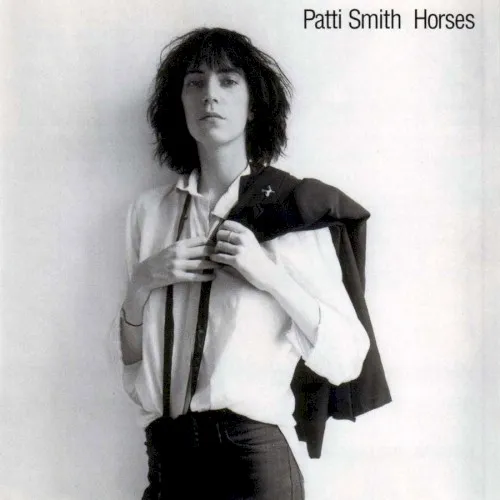
Full Review
AI-assisted, human-reviewed
Horses
Patti Smith
On Horses, the band converts Patti Smith's syntax into momentum, interruption, and collective form instead of treating her poetry as a separate lead layer.
The challenge arrives before the music
Horses begins with a person claiming the room before the band has established a song. Patti Smith’s first sentence is delivered almost alone, at conversational speed, with no melodic display to soften its refusal. The entrance matters because it defines the album’s working relationship. Voice is not one layer waiting to be balanced against guitar, piano, bass, and drums. It is the event to which those instruments must respond.
That relationship had been developed in poetry readings and New York club performances before John Cale produced the album at Electric Lady Studios. Lenny Kaye, Ivan Král, Richard Sohl, and Jay Dee Daugherty do not treat Smith as a reciter who happens to have a rock group behind her. They listen for pressure inside her phrasing: a repeated word, an accelerated clause, a pause that might become a count-in. The songs gain form as the band recognizes those signals and turns them into riffs, crescendos, and changes of gait.
Horses makes language a practical problem for a band, then lets the process of solving it remain audible. Poetry and music meet through timing rather than prestige.
Borrowed songs become contested ground
Two of the album’s largest pieces contain earlier rock songs: Them’s “Gloria” and Chris Kenner’s “Land of a Thousand Dances.” Smith neither hides those sources nor approaches them with museum respect. Familiar material gives the listener a stable outline, which she can occupy, interrupt, and redirect. Authorship becomes something performed rather than settled by the writing credit.
Gloria: A cover reclaimed in stages
“Gloria” joins Smith’s poem “Oath” to the garage-rock standard. At first, the borrowed song is barely present. Her dry, close vocal establishes its own pace while guitar answers with small figures instead of announcing the famous riff at full weight. Piano, bass, and drums enter by degrees. The three-chord cycle eventually becomes unmistakable, but by then Smith has changed what its arrival means.
The performance does not reverse the original narrative with one lyrical substitution. It redistributes authority over time. Smith moves from speech into pitch, from private address into group chant, and the band grows more forceful as her diction becomes more repetitive. When the song reaches its familiar spelled-out refrain, recognition feels less like a return to the source than the completion of a takeover. A standard built for directness has been made to contain hesitation, argument, and self-invention.
A band learns to move with speech
Calling the rhythm section primitive misses its harder task. The musicians must be steady enough to give Smith resistance and flexible enough to follow a sentence that may lengthen without warning. Their economy keeps the voice legible while small changes in density tell the listener how far a passage has travelled.
Birdland: Narration teaches the band to rise
“Birdland,” inspired by Peter Reich’s account of his father, begins around Richard Sohl’s circling piano and Smith’s patient narration. There is no conventional verse whose return promises orientation. Instead, guitar color and cymbal activity accumulate as the boy’s vision becomes more urgent. Smith shortens the distance between spoken rhythm and singing: syllables stretch, pitches climb, and repeated phrases cease to explain the scene and start to enact it.
The band follows that transformation without illustrating every image. Daugherty increases the physical insistence, Kaye and Král thicken the harmony, and Sohl’s figure changes from setting to propulsion. The long ascent works because no single cue starts it. Voice and ensemble keep handing momentum to one another until narration has become collective motion.
Short songs alter the pressure
The tighter pieces prevent openness from becoming the album’s only method. “Free Money” drives a fantasy of escape with bright piano and increasingly impatient drums. “Kimberly” sets protective language against a compact rock arrangement, while “Break It Up” uses a slower, more deliberate rise. Smith can disturb a familiar form within a compact song as well as across a nine-minute ascent.
Redondo Beach: A light groove refuses the story
“Redondo Beach” makes the sharpest contrast. Offbeat guitar, mobile bass, and an easy reggae-derived pulse create social lightness beneath a search that ends in death. Smith does not sing the story as a continuous lament. Her clipped lines sit inside the groove, and the refrain returns with a calm that grows more troubling each time.
The arrangement refuses to certify the lyric’s emotion. That separation gives the song its force: tragedy is not announced by a minor-key collapse, and the band does not abandon its poise to prove that the words matter. The listener has to hold incompatible signals at once. Here the ensemble is not following Smith’s rising intensity; it is supplying the distance against which her account becomes credible.
Land risks losing its boundary
Land: A suite held together by return
“Land” exposes the album’s method across its longest span. A spoken scene around the figure of Johnny moves through incantation, violent interruption, the dance command of “Land of a Thousand Dances,” and echoes of language heard earlier on the record. The band repeatedly finds a pulse, pushes it toward frenzy, and lets Smith break its frame. Return rather than plot holds the suite together: gestures recur changed by what has happened between them.
The scale permits a remarkable transition from private vision to communal rock ritual. It also reveals the cost of the album’s freedom. Once the central mechanism is understood, some later surges confirm intensity rather than redirect it. The performance remains alive, but duration occasionally substitutes for a new dramatic decision. “Elegie,” sparse and mournful after that excess, closes the record with atmosphere more than resolution. Its brevity is welcome, though it leaves several of the album’s tensions deliberately open.
Authorship stays in motion
Horses did not need to invent rock vocabulary to change who could command it. Its basic materials—three-chord songs, backbeats, piano figures, repeated refrains—were already worn smooth. Smith and the band make them unstable by changing the chain of command. Sometimes the voice sets the pace; sometimes a groove contradicts the words; sometimes an inherited song provides the wall that Smith pushes against.
The looser passages do not all justify their length equally, and the compact songs can make the band’s language sound more conventional. Those limits belong to the same wager as the album’s strengths. Horses lets form emerge from attention among musicians rather than from a fixed separation between poem, singer, and accompaniment. The band discovers that the poem has already changed the beat.
The argument
Strengths and limits
Strengths
- Smith's phrasing actively changes how the band builds and releases momentum.
- Borrowed rock forms become material for a distinct argument about authorship.
Limits
- The open forms occasionally preserve intensity after their dramatic direction is clear.
Further reading: Sony Legacy's Horses 50th-anniversary notes
Documentation
Sources
- Legacy Recordings celebrates the 50th anniversary of Horses, Sony Music. Accessed August 7, 2026.
- Horses — Patti Smith (1975), Library of Congress. Accessed August 7, 2026.
- Horses release group and credits, MusicBrainz. Accessed August 7, 2026.
- Patti Smith's Horses married poetry and rock'n'roll, ABC Double J. Accessed August 7, 2026.
Album artwork remains the property of its respective rights holders. It is reproduced at limited resolution on this review page for identification and critical context.