 Reviews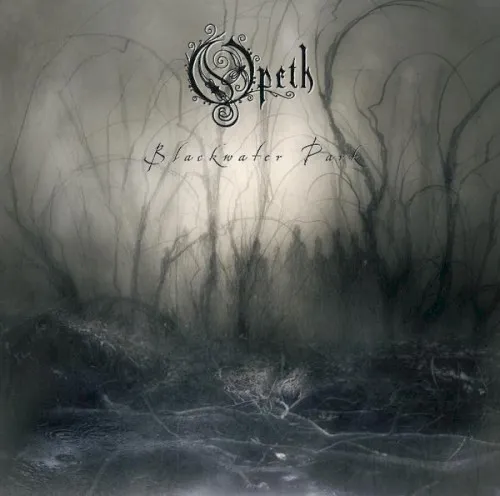
Full Review
AI-assisted, human-reviewed
Blackwater Park
Opeth
Blackwater Park treats heaviness as a change in pressure rather than a fixed sound; its quiet passages alter the force and meaning of every return.
Pressure, release, and return
The first riff of “The Leper Affinity” does not introduce Blackwater Park gradually. Guitars, bass, drums, and Mikael Åkerfeldt’s growl arrive as a single hard surface. Four minutes later, that surface has vanished. Clean guitar figures leave wide gaps around themselves, and a piano closes the song after the band has rebuilt its full weight.
The quieter writing changes how the heavy material is heard when it returns. A riff can feel more severe after the ear has adjusted to fingerpicked strings; a clean vocal can make the next growl sound less like genre grammar and more like a character losing control.
The method gives eight long tracks a clear physical logic. Pressure rises, recedes, and returns in altered form. The strongest changes affect memory as well as volume.
A larger room for the same band
The album was Opeth’s fifth and its first for Music for Nations. Mikael Åkerfeldt produced it, with Steven Wilson credited as co-producer and engineer. Wilson also added clean vocals, guitar, and keyboards. Fredrik Nordström, Wilson, and Opeth mixed the record, and the official credits place Åkerfeldt, Peter Lindgren, Martín Méndez, and Martin Lopez at the center of the performances.
The record’s expansion is audible as separation. The two guitars can hold different textures without collapsing into one midrange block. Méndez’s bass remains a moving line beneath clean passages, while Lopez often avoids a straight double-kick drive in favor of syncopation, cymbal detail, and a loose pull around the beat. Wilson’s vocal layers widen Åkerfeldt’s clean melodies without turning them into glossy choruses.
The writing still depends on abrupt joins. Opeth had not become a band of seamless through-composition. Yet the production lets the joins breathe, so a hard cut can sound like a change of scene rather than an editing problem.
Four tests of the album’s contrasts
Bleak: A second voice changes the center
“Bleak” opens with a descending guitar pattern that feels heavy because each accent drags against Lopez’s more mobile pulse. Åkerfeldt’s growl occupies the center until the clean refrain arrives. Wilson’s higher supporting voice does not merely sweeten it. The added register makes the melody feel detached from the body that delivered the verses.
Acoustic strumming and hand-percussion color then clear space without stopping the song’s motion. When distorted guitars return, the earlier descent carries a different pressure: the riff now sounds like something the clean section failed to escape. Contrast supplies the drama that a lyric sheet alone cannot.
Harvest: Restraint without an approaching explosion
The largely acoustic “Harvest” stands on its own rather than functioning as a long countdown to distortion. Åkerfeldt sings in a narrow, controlled range while layered guitars move through dark chord changes. Méndez and Lopez maintain a quiet pulse that keeps the track from becoming a decorative ballad.
Placed between two extended compositions, the song resets the listener’s sense of scale. Its restraint also proves that Opeth’s melancholy is not dependent on growls or amplified mass. The record can sustain unease at conversational volume.
The Drapery Falls: A return gains narrative force
Clean guitars establish “The Drapery Falls” for several minutes before the harsher voice and denser riffing take control. The crucial move comes later, when the opening material returns. It is recognizably the same figure, but the intervening violence has changed its emotional temperature.
Opeth’s long form lets the musical idea acquire history. The return sounds damaged by what has happened between appearances, rather than serving as a chorus reward or a display of compositional symmetry.
Blackwater Park: Accumulation reaches its limit
The title track removes the album’s gentler conclusion. A spare opening soon gives way to one of the record’s bluntest riffs, with vocals and guitars locked into short, downward gestures. Later acoustic space delays the final run rather than softening it.
The closing minutes accumulate riffs with impressive control, but they also expose the method’s limit. By this point the listener knows that quiet detail will prepare another heavy return. The finale compensates through rhythmic authority and the ugliness of its last refrain, not through a new formal answer. It ends the record decisively while repeating its most familiar bargain.
Detail that survives the scale
Details remain audible during the album’s largest passages. Lopez can shift the gait of a riff without weakening it. Méndez gives the acoustic sections a low current. Lindgren and Åkerfeldt separate chord weight from melodic movement, allowing one guitar to sustain pressure while the other traces an exit.
Åkerfeldt’s two vocal modes are equally structural. His clean singing creates distance and inward focus; the growl collapses that distance. Because the arrangements leave room for both, neither voice feels like a compulsory genre feature. Each identifies a different relation to the same bleak material.
When the architecture becomes visible
Repeated contrast eventually creates expectation. “Dirge for November” and “The Funeral Portrait” contain finely judged details, but their movement from exposed space toward distorted force follows a route the earlier songs have already mapped. The changes still work moment by moment; their destination is less surprising.
The title track has a related problem. Its final accumulation is powerful, yet it resolves the album by applying more pressure rather than reconsidering the pattern. A shorter or more radically emptied ending might have made the record’s last weight harder to predict.
Heaviness as a memory
Blackwater Park’s force is relational. Acoustic guitar and distortion make one another more specific. The quiet passages give riffs a past; the riffs give quietness a threat.
Opeth repeats that design often enough for its seams to show. Even so, the performances keep the scale human: a drum accent alters the gait, a bass line maintains tension, and a second voice changes the point of view. The album’s weight is measured by what disappears before it comes back.
The argument
Strengths and limits
Strengths
- Acoustic passages change the weight of surrounding riffs instead of serving as ornamental interludes.
- Mikael Åkerfeldt's clean and harsh voices give long arrangements distinct dramatic positions.
Limits
- Several songs rely on the same clean-to-distorted escalation, making some later returns easier to predict.
- The dense title track resolves the album through accumulation more than fresh contrast.
Further reading: Opeth official album archive
Documentation
Sources
- Blackwater Park track list, credits, and personnel, Opeth. Accessed July 28, 2026.
- Blackwater Park release group and editions, MusicBrainz. Accessed July 28, 2026.
- Blackwater Park standard album track listing, Spotify. Accessed July 28, 2026.
- Mikael Åkerfeldt on Blackwater Park after 25 years, Metal Hammer. Accessed July 28, 2026.
Album artwork remains the property of its respective rights holders. It is reproduced at limited resolution on this review page for identification and critical context.