 Reviews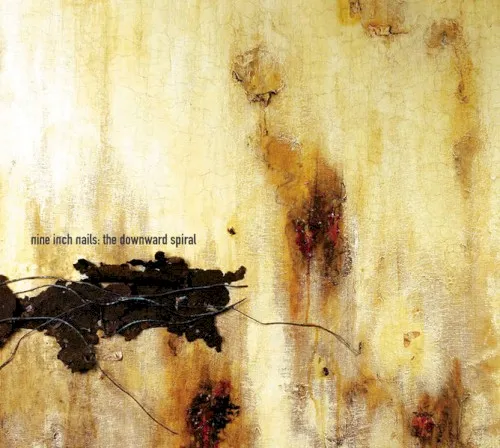
Full Review
AI-assisted, human-reviewed
The Downward Spiral
Nine Inch Nails
The Downward Spiral uses meticulous production to make control itself the mechanism of collapse, rather than simply depicting a man who loses it.
A machine built to fail
The Downward Spiral begins with a sampled beating and ends with a piano trying to hold its shape under a blanket of hiss. Between those points, Trent Reznor constructs a record about self-erasure with obsessive precision. That precision is the crucial contradiction. The speaker insists that appetite, cruelty, sex, and isolation will make him sovereign, while the music keeps demonstrating how completely those impulses govern him.
Sounds recur in altered states across the album. A guitar can arrive as impact, residue, or electronic grit; a rhythm can command the body before breaking into debris. Reznor’s control of the studio exposes control as fantasy.
That control extends to memory. The descending keyboard phrase heard near the end of “Closer” returns in the title track, slowed and drained of its earlier sensual pull. The abrasive tail of “Mr. Self Destruct” bleeds into “Piggy,” where an almost empty drum kit and a murmured vocal replace command with watchfulness. These are not reprises in a rock opera’s explanatory sense. They are damaged recognitions: material that once seemed to belong to one desire comes back carrying the consequences of another.
Le Pig as an instrument
Much of the album was made at Le Pig, Reznor’s studio in the Los Angeles house where members of the Manson Family murdered Sharon Tate and four others in 1969. The location became part of the record’s public mythology, but its musical importance is more practical: Reznor could treat the building as a laboratory. He produced with Flood, while Alan Moulder mixed much of the material; Adrian Belew supplied guitar textures rather than conventional lead parts.
The result does not divide cleanly into band and electronics. Live playing is sampled, reassembled, and forced against programmed patterns. Distortion is rarely a single guitar tone. It is a method of removing stable edges from drums, voices, and rooms. Even silence is designed: it creates a temporary boundary that the next sound can violate.
Reznor also refuses a hierarchy in which a “real” instrument provides human truth and a machine supplies alienation. The loose, closing drum performance in “Piggy” can sound as unsettled as any edited loop. The piano in “The Becoming” is less comforting than the surrounding electronics because its plainness exposes the voice beside it. Conversely, the synthetic pulse in “Closer” is one of the album’s most bodily sounds. The production keeps exchanging those roles, so no timbre offers moral shelter.
Three stages of command
Mr. Self Destruct: The loop takes authority
The opener establishes power through repetition. Its main programmed attack is less a groove than a recurring blow; the guitars answer with compact, downward pressure. Reznor begins in a near-whisper, then doubles and distorts his voice until the supposed first-person declaration sounds occupied by several competing selves. When the arrangement dissolves into Belew’s scraped, unstable guitar texture, aggression has not produced release. It has consumed the song’s ability to stand upright.
March of the Pigs: Refusing the expected bar
“March of the Pigs” repeatedly cuts a fast, lurching pattern against abrupt stops. The drums feel physical and almost playable, yet the edits deny a comfortable continuous performance. Its quiet piano interruption does not calm the track; it exposes how coercive the surrounding motion has become. The final return lands before the listener can settle, making impatience a structural principle rather than a shouted attitude.
Closer: Desire inside a locked grid
“Closer” is often detached from the album as a provocation, but its arrangement is coldly restrictive. The kick and bass figure leave little harmonic movement, while small noises enter with assembly-line regularity. Reznor’s vocal grows more explicit as the track becomes more mechanically assured. Desire promises escape from the self, yet every added layer closes the grid. The ending’s descending keyboard figure will return elsewhere, turning apparent climax into another link in the sequence.
The three tracks also describe different kinds of time. “Mr. Self Destruct” repeats until its components decay; “March of the Pigs” withholds a stable measure; “Closer” makes its loop feel inescapably permanent. None simply illustrates a lyric. Each gives the speaker a structure he believes he can use, then lets that structure assume control.
Calm is not outside the system
“A Warm Place” initially appears to offer the record’s only unguarded refuge. Its slow-moving synth chords avoid percussion and let tones overlap without collision. Placed after “Big Man with a Gun,” however, the piece cannot erase what precedes it. It is a room the record permits for four minutes, not a door out.
Earlier, “Ruiner” stages a related false exit in miniature. Its first half locks voice and programmed rhythm into a clenched pattern; the guitar solo suddenly opens a wide melodic space, but its smeared bends and oversized sustain feel less like freedom than a fantasy of heroic rock expression. “The Becoming” reverses that move. A recurring mechanical figure is crowded by screams and acoustic guitar, joining incompatible spaces until the quiet instrument sounds like the intrusion.
In the second half, “Eraser” develops from breath and percussion into a wall of clipped guitar; “Reptile” makes disgust monumental through a heavy, even pulse. The title track then miniaturises catastrophe: distant guitar and muted narration make violence sound already remembered. Production keeps changing scale, but never leaves the speaker’s closed circuit.
The cost of one perspective
The album’s unity is also its clearest limitation. Other people appear largely as targets, instruments, or threats inside the protagonist’s account. The sequence critically dismantles his fantasies, but it grants no competing voice enough space to challenge them directly. That sealed perspective is dramatically coherent and ethically airless.
It also gives the record a narrow emotional vocabulary despite its vast sonic one. Contempt, shame, appetite, and numbness change intensity and texture, but care is mostly present as something already forfeited. “A Warm Place” and “Hurt” suggest tenderness by reducing force; neither can imagine a durable relationship in which tenderness might be tested. The absence is central to the portrait, yet an hour inside it can make rigor feel like enclosure.
The record also invites selective listening that can flatten its argument. A phrase from “Closer” or the swagger of “Big Man with a Gun” can function as blunt transgression when lifted from the surrounding descent. The album supplies the consequences, but not within every song. Its architecture asks more of the listener than its most exportable moments do.
A damaged trace survives
“Hurt” does not resolve the spiral. Piano, guitar, and voice remain exposed, but static keeps the performance from becoming clean confession. Reznor sings with less theatrical force, as though the record’s many vocal masks have worn through. The final surge overwhelms rather than redeems him, then leaves a faint resonant trace.
Its melodic restraint is as important as its quietness. The verse circles a small group of notes and lets pauses expose the grain of the vocal. When the harmony finally thickens, the song does not discover a new language; it magnifies the few elements still available. The effect is not purification after noise. It is the recognition that even a nearly bare arrangement remains inside the system the album has built.
Every break, recurrence, and corrupted surface on The Downward Spiral has been placed exactly. The album engineers collapse so carefully that mastery and ruin become indistinguishable.
The argument
Strengths and limits
Strengths
- Recurring noises and motifs make the sequence behave like one tightening mechanism.
- Extreme contrasts in texture give psychological changes a physical architecture.
Limits
- The protagonist's sealed perspective leaves little room for another consciousness.
- Its provocation can be mistaken for endorsement when separated from the album's arc.
Further reading: Nine Inch Nails discography
Documentation
Sources
- The Downward Spiral discography entry, Nine Inch Nails. Accessed August 7, 2026.
- The Downward Spiral release and credits, MusicBrainz. Accessed August 7, 2026.
Album artwork remains the property of its respective rights holders. It is reproduced at limited resolution on this review page for identification and critical context.