 Reviews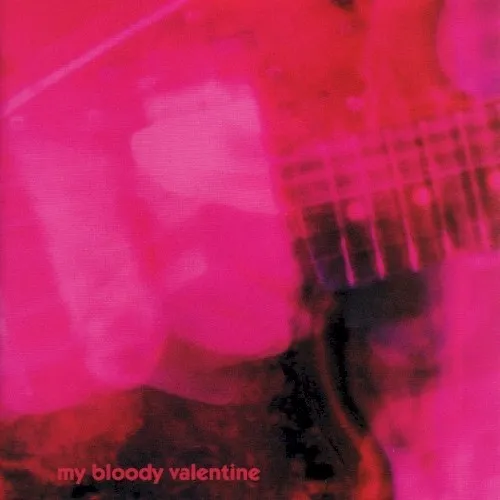
Full Review
AI-assisted, human-reviewed
Loveless
My Bloody Valentine
Loveless organizes its blur precisely: pitch keeps moving, voices live inside the chords, and rhythm stops the surface from becoming static.
The surface refuses to sit still
Loveless is often described as a wall of sound, a phrase that catches its density and misses its behavior. Walls do not bend when a hand touches them. They do not make a chord seem to inhale between one beat and the next. My Bloody Valentine’s second album feels vast because its surface is always yielding, not because the band simply stacked more material.
Kevin Shields found much of that movement by holding the tremolo arm while strumming. The gesture pulls whole chords in and out of tune together. Conventional vibrato decorates a stable pitch; this technique makes stability temporary. A listener can identify the chord’s general color while its exact position keeps slipping. Bilinda Butcher and Shields sing with the same refusal of hard edges, sustaining vowels where consonants would otherwise divide the line.
The songs beneath that treatment are compact. Verses repeat, melodies return, and several tracks depend on one central rhythmic idea. Loveless becomes strange by denying those forms a reliable foreground. Guitar can act like percussion, voice can complete a chord, and a sample can supply what appears to be an instrument. Melody is not hidden under the production. It has been distributed through it.
A small arrangement made to feel immeasurable
The album’s mythology encourages visions of endless overdubs. Shields has described a much leaner method: often one or two guitar tracks, little panning, and fewer conventional effects than the sound suggests. Reverse reverb is important, but so are performance, compression, varispeed, sampling, and the decision not to separate every element into a clean studio slot.
The limited number of tracks preserves the attack that makes each chord buckle. Pressed into the same middle register, their boundaries become ambiguous while their physical impact stays intact. The ear hears scale without receiving a tidy inventory.
The production also resists the high-gloss stereo space common to ambitious guitar records. There is little sense of players arranged across a stage. Sounds meet near the center, where compression makes drums, guitar, and voice change one another’s apparent size. When a snare hits, the guitar seems to recoil; when a vocal enters, it does not float above the chord but slightly alters its color. The mix behaves less like a photograph of a band than a membrane responding to pressure.
Rhythm under the weather
For all its pitch instability, Loveless depends on firm rhythmic frames. Colm Ó Cíosóig’s drums, programmed patterns, tambourine, and loops give the bent guitars something to resist. The record’s characteristic sensation comes from that disagreement: the beat repeats while the harmony appears to lean across it.
“Only Shallow”: impact without a hard edge
The opening drum strikes announce a rock record with almost comic directness. The guitar answer immediately complicates that promise. Its pitch rises and falls inside the chord, and the bright upper noise has no single attack point. Each return is both a riff and a burst of weather.
Butcher’s verse narrows the space. Her melody is brief and calmly repeated, with the guitar reduced to a lower, pulsing mass behind it. The chorus does not introduce a larger tune; it restores the opening pressure. That alternation gives the song a conventional skeleton while reversing conventional scale. The intimate passage carries the explicit melody, and the huge passage communicates through timbre and impact.
“To Here Knows When”: no bass, yet gravity
“To Here Knows When” seems almost detached from pulse. A soft guitar was sent through reverse reverb, re-amped, and surrounded by programmed drums, live tambourine, sampled feedback, and a low rumble taken from a sound-effects recording. There is no bass guitar. The track still feels heavy because low frequency has been treated as environment rather than a line.
Butcher’s voice occupies the same uncertain zone as the guitar. Phrases appear, blur at their ends, and leave traces that the next sound absorbs. The tambourine is crucial: its dry metal ticks establish distance and prevent the track from dissolving into an ambient wash. Gravity comes from contrast between a barely visible grid and a surface that will not hold still.
Voices inside the chord
The vocals are commonly called buried, but their function is closer to embedded. Shields and Butcher do not sing as quietly as the finished mix implies; controlled tone and dense midrange remove the signs of exertion. Their voices carry words, but they also occupy the frequency space that a lead guitar or keyboard might claim on another record.
That choice changes the listener’s relation to language. Individual words arrive without guaranteeing a complete narrative, so vowel shape, breath, and melodic contour bear more weight. Lyrical detail becomes difficult to recover, and the songs can withhold more semantic information than some listeners will accept. But the voices remain distinct: Butcher’s lighter grain and Shields’s narrower, more nasal tone make different kinds of pressure inside the mix.
“When You Sleep”: the hook loses its owner
“When You Sleep” contains one of the album’s clearest lead melodies, a bright figure that could be played by guitar, keyboard, or a processed voice. Its source matters less than the way it moves between identities. The vocal blend works similarly: multiple takes thicken the line until a single singer is hard to locate, even though the tune remains immediate.
The drums keep the song buoyant while guitar chords drag slightly around the beat. That split gives the hook its emotional ambiguity. It feels eager because the rhythm pushes forward and unsteady because pitch never fully settles. Pop directness and studio disorientation are not opposites here; each makes the other audible.
The blur has boundaries
The album is less varied than its reputation for limitless possibility suggests. Its middle register dominates, bass guitar is often recessed, and several drum parts have the reduced depth of programmed or heavily compressed sound. On “I Only Said” and “Come in Alone,” those constraints generate useful momentum: repeated figures become hypnotic because little escapes the central band of pressure.
Across the second half, however, the shared treatment can weaken distinction. “What You Want” has a strong rushing pulse, but its guitar-vocal relationship restates effects already explored with sharper contrast. At moderate volume or through small speakers, the internal changes are easy to flatten into one continuous haze. The record benefits from attention that its surface initially seems to refuse.
“Sometimes” demonstrates another path. A close, persistent strum supplies a tactile center while distortion accumulates around it. Shields’s melody remains plainly shaped even when the words recede. The track feels enormous without abandoning the small motor that drives it. The less distinct passages let scale replace the specific gesture that “Sometimes” keeps audible.
“Soon” opens the floor
The closing “Soon” does not clear away the album’s methods. Guitar still bends, vocals still merge with surrounding frequencies, and sampled texture still complicates the instrumental picture. What changes is the authority of the beat. A dance-derived loop and mobile bass line make repetition feel social and bodily rather than enclosed.
Placed last, the track reveals how rhythmic the whole album has been. Earlier songs let drums hold a fixed point while pitch moved around them; “Soon” turns that fixed point into the main event. The guitar no longer seems to obscure a groove. Its swells ride the groove and alter the air above it.
“Soon” exposes the limit of the wall-of-sound description. Loveless is porous, unstable, and carefully bounded. Simple forms remain inside the noise, but production changes how they reach the body: a melody can be felt as a shift in pressure, a voice as a new color in the chord, a beat as the one surface that does not bend. The album’s blur comes from those decisions.
The argument
Strengths and limits
Strengths
- Unstable pitch and compressed dynamics turn simple song forms into physical environments.
- Voices function as melodic material without losing their human grain.
Limits
- The dense midrange makes several second-half songs less distinct at ordinary volume.
- Recessed bass and programmed drums sometimes narrow the band's physical range.
Further reading: Kevin Shields on My Bloody Valentine's history and methods
Documentation
Sources
- Loveless album and track list, My Bloody Valentine. Accessed August 9, 2026.
- Loveless release group and editions, MusicBrainz. Accessed August 9, 2026.
- My Bloody Valentine: Kevin Shields' Recording Secrets, Tape Op Magazine. Accessed August 9, 2026.
Album artwork remains the property of its respective rights holders. It is reproduced at limited resolution on this review page for identification and critical context.