 Reviews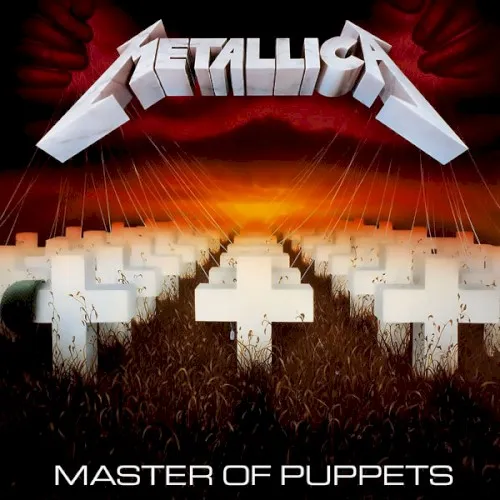
Full Review
AI-assisted, human-reviewed
Master of Puppets
Metallica
Master of Puppets makes control audible through exacting riffs and repeated commands, while its arrangements keep changing who or what appears to be in charge.
The riff gives the orders
Master of Puppets is full of people trapped inside systems: dependency, warfare, religious fraud, institutional confinement. Metallica does not leave that control in the lyrics. James Hetfield’s rhythm guitar turns it into a bodily fact. Down-picked figures advance with almost no slack, accents arrive before a listener has settled into the bar, and repeated notes make stopping feel less possible than continuing.
The album would be much smaller if that pressure never changed. Its eight songs keep opening trapdoors beneath their own authority. Acoustic guitars introduce “Battery.” The title track suspends its central attack for a clean, melodic middle. “Orion” removes the voice entirely and lets bass, harmony, and tempo carry the argument. Control is the subject, but changing form is the method.
Metallica constructs firm surfaces and then alters the terms beneath them. A riff may dictate the motion for a minute, yet a new register or pulse can expose it as one part of a larger arrangement. Precision stays alive through that transfer of command.
Eight songs under pressure
Metallica recorded the album at Sweet Silence Studios in Copenhagen from September to December 1985. The band’s official credits name Metallica and Flemming Rasmussen as producers and Rasmussen as engineer; Michael Wagener mixed the record in Los Angeles. The same studio and producer had served Ride the Lightning, but the third album tightens that record’s expanding forms. The acoustic passages, instrumentals, and long songs now belong to a sequence with unusually strict proportions.
The first side moves from the ignition of “Battery” into the title track’s extended architecture, then slows into “The Thing That Should Not Be” before “Welcome Home (Sanitarium)” builds from exposed guitar to release. The second side follows a related curve: “Disposable Heroes” begins at full pressure, “Leper Messiah” works at a heavier mid-tempo pace, “Orion” creates an instrumental clearing, and “Damage, Inc.” closes with speed. The resemblance is deliberate enough to bind the record, though it also creates one of its limits. By the final track, the listener understands that calm will often be answered by acceleration.
Within that design, the four musicians keep distinct roles. Lars Ulrich favors hard section boundaries, cymbal cues, and fills that announce a turn. Kirk Hammett’s leads bring a looser, more vocal contour to Hetfield’s compact rhythm playing. Cliff Burton’s bass often reinforces the guitar mass, but his writing and playing widen the harmonic field whenever the arrangement makes space for them.
Four struggles over command
Battery: Speed has to be earned
“Battery” begins with acoustic guitars, not a false quiet but a compressed model of what follows. A single line gathers harmonies and weight until the distorted band restates its shape at a different scale. When the thrash rhythm enters, speed feels like a consequence of accumulated tension rather than the album’s default setting.
Hetfield’s main figure is clipped and percussive. The guitar does the work of both riff and additional drum, while Ulrich’s snare keeps the forward motion legible. Brief breaks around the vocal prevent the attack from becoming a continuous blur. Each return sounds more compulsory because the arrangement has shown that another texture was possible.
Master of Puppets: The bar line loses authority
The title track’s main riff pulls against a regular grid through its accents. Hetfield’s vocal enters with a squarer, commanding shape, so guitar and voice impose different kinds of order at once. The chorus opens the register without relaxing the lyric’s coercion.
Midway through, clean arpeggios replace the down-picked surface. A harmonized guitar line grows into Hammett’s solo, and for several minutes the song seems to have found distance from its central mechanism. The return matters because it proves the distance temporary. The main riff has not disappeared; the arrangement has made the listener experience its absence, then placed the body back under it.
Disposable Heroes: Repetition becomes labor
“Disposable Heroes” uses duration differently. Its repeated low-string figures feel less like suspense than assigned work. Ulrich keeps the beat rigid, Hetfield drives the same physical motion through verse after verse, and the shouted refrain reduces a life to an instruction. The anti-war argument is carried by exhaustion as much as by language.
The song’s length is both effective and costly. Repetition makes obedience tangible, but the later returns add force more readily than information. Metallica accepts that trade: the arrangement does not merely describe a machine; it makes the listener remain inside one.
Orion: Control passes to the ensemble
Without a vocal, “Orion” cannot rely on an explicit figure of authority. Its opening bass texture and measured riff establish mass, while the central section changes the album’s emotional temperature. Burton’s melodic bass rises into a more open harmonic space; layered guitars answer rather than dominate it.
The piece still depends on repetition, but no single part dictates how to hear it. Bass, rhythm guitars, lead lines, and drums trade prominence as the sections unfold. Near the end of an album concerned with control, that collective motion changes the argument. “Orion” does not escape structure. It shows structure without a commander.
Precision with moving parts
The long arrangements remain legible. Their contrasts justify the duration and stay connected to the main argument. Clean guitar changes how force is measured when distortion returns. Slower riffs reveal how weight can govern the body as effectively as speed.
Hetfield’s rhythm playing gives the record its hard edge, yet the ensemble prevents that edge from becoming a single color. Hammett stretches phrases over the grid. Ulrich marks the doors between sections. Burton supplies harmonic movement that is most audible when the guitars loosen their grip. The forms demand exact performances and clear transfers between players.
Where the design starts to show
The sequence is so balanced that its answers can become foreseeable. “Welcome Home (Sanitarium)” and “Disposable Heroes” are very different songs, but the album repeatedly uses escalation to convert reflection into force. “Damage, Inc.” remains a ferocious closing performance; as a structural move, its return to speed completes a pattern the listener already knows.
The guitar sound also occupies so much of the middle and low register that Burton’s bass can merge into the total pressure. “Orion” proves how much melodic and textural information he can provide when given room. Elsewhere, that individuality is easier to feel as weight than to follow as a line. The density supports the album’s argument, but it narrows one of its most resourceful voices.
No riff rules for long
Master of Puppets makes domination physical without confusing force with sameness. Its riffs issue orders, but its arrangements keep changing the source and scale of those orders. Acoustic detail becomes electric mass; speed gives way to suspension; a vocal command yields to an instrumental conversation.
The recurring architecture occasionally exposes its own plan, and the rhythm-guitar density can hide as much as it unifies. Metallica built a record about control in which no riff is allowed to rule unchanged for long.
The argument
Strengths and limits
Strengths
- Long arrangements change pace and texture without surrendering their central tension.
- James Hetfield's rhythm guitar turns lyrical systems of control into physical pressure.
Limits
- The album's carefully balanced sequence can make its structural recurrences predictable.
- Dense rhythm guitars sometimes compress the bass into the ensemble's low-end force.
Further reading: Master of Puppets on Metallica's official site
Documentation
Sources
- Master of Puppets track list and liner notes, Metallica. Accessed August 1, 2026.
- Metallica history and Master of Puppets sessions, Metallica. Accessed August 1, 2026.
- Master of Puppets National Recording Registry essay, Library of Congress. Accessed August 1, 2026.
- Lars Ulrich interview for the National Recording Registry, Library of Congress. Accessed August 1, 2026.
Album artwork remains the property of its respective rights holders. It is reproduced at limited resolution on this review page for identification and critical context.