 Reviews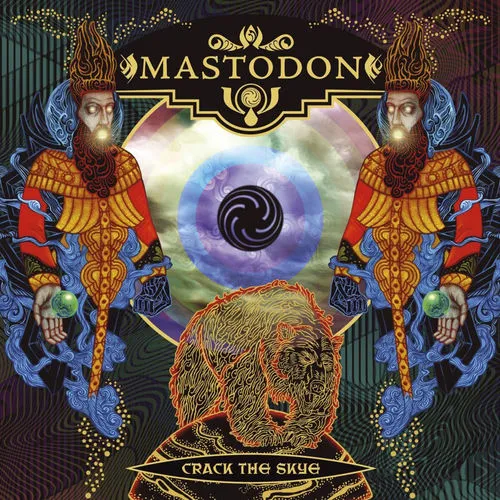
Crack the Skye
Mastodon
Crack the Skye ties progressive detail to grief and physical distance, but the concept sometimes asks transitions to carry weight the songs have already earned.
AI-assisted, human-reviewed
Distance inside the machinery
“Oblivion” begins with Brann Dailor singing over a guitar pattern that climbs without finding stable ground. His voice is clear and exposed, very different from the bark and roar that had defined much of Mastodon’s earlier work. When Troy Sanders and Brent Hinds take later lines, the change is not decorative variety. Each singer locates the song at a different distance from its fear.
That distribution gives Crack the Skye a human center before its astral travel and historical narrative take over. The album’s concept follows a chain of spectacular events, while the music concentrates on separation: a body from consciousness, a child from home, a voice from the person it wants to reach.
Guitars by Hinds and Bill Kelliher maintain detail without filling every register. One part often holds a repeating shape while the other bends or climbs around it. Dailor’s drums are active, but his singing changes the role of that activity. The fills sound less like technical display than a body refusing stillness.
Seven pieces, three lead voices
“Divinations” compresses the album’s language into a direct charge. Banjo color at the opening is brief, not a claim to stylistic fusion. The band then drives through a galloping figure while Hinds’s vocal gives the track a rough edge. Its concision is important because the record will soon ask for much longer attention.
“Quintessence” turns syncopation into upward motion. Guitar accents and Dailor’s drums keep shifting the point of impact, but the chorus opens with a melodic clarity that prevents the song from sounding trapped in its own design. Mastodon uses complexity best when a listener can feel what the change accomplishes before naming it.
The production leaves the instruments more air than on earlier Mastodon records, where density itself could be exhilarating. Bass is audible as movement rather than only mass, cymbals decay, and vocal layers retain different textures. The album is polished, but not polished into anonymity.
Where the concept becomes audible
Oblivion: Three voices establish distance
Dailor sings the exposed opening over guitars that climb without settling. His clear tone is a deliberate change from the rougher vocal language of earlier Mastodon records. When Sanders and Hinds take later lines, the handoff does more than provide variety: each singer places the same crisis at a different emotional distance.
The instrumental writing supports that division. One guitar sustains a repeating contour while the other bends around it, and Dailor’s fills repeatedly change where the cycle seems to land. The technique is dense, but its dramatic purpose is easy to hear. The song never establishes one stable narrator or one stable floor.
The Czar: Four sections test the concept’s weight
The suite’s named parts remain audible in the music. “Usurper” establishes a processional pace, “Escape” increases motion, and later returns make the opening material sound less ceremonial and more trapped. Sanders supplies the low authority the historical subject invites; Hinds introduces a thinner, more agitated edge.
The audible joins prevent ten-plus minutes from becoming an undifferentiated mural. In the middle passages, however, the album’s grandeur becomes a constraint. Several transitions move the plot forward while preserving nearly the same emotional height. The musicianship stays alert, but the suite could use a deeper change of temperature before its closing spiral.
Crack the Skye: Grief interrupts the adventure
Scott Kelly’s guest vocal brings a single severe grain to the title track. The band answers with a slower rise and fewer rhythmic detours than it uses elsewhere. Guitar lines climb, but they keep returning to the central weight instead of converting grief into a technical climax.
The album’s title also invokes Dailor’s sister Skye, whose death is part of the record’s emotional frame. That knowledge can overwhelm criticism if treated as an automatic guarantee of depth. The arrangement earns the association through restraint: the voice sounds as if it is trying to cross a distance, and the music refuses to pretend that distance can be closed neatly.
The Last Baron: A late groove earns the scale
The finale spends its early minutes alternating uncertain vocal passages with riffs that arrive, withdraw, and return in new proportions. A quieter middle reduces the pressure before the band reaches the crooked late groove. That figure swings more openly than much of the album and supplies bodily pleasure after a sequence dominated by strain.
The previous complexity remains inside the groove. Dailor accents within it, the guitars retain contrary motion, and the return of earlier material carries residue rather than triumph. Thirteen minutes are justified by changes in proportion rather than constant escalation. The story reaches an ending; the voices still sound marked by the journey.
Precision with human stakes
The three lead singers give the concept human positions. Dailor can sound exposed, Sanders authoritative, and Hinds frayed; the changes help a listener follow emotional distance even when the plot moves through astral projection and Rasputin. Scott Kelly’s single severe tone on the title track works because the album has already taught the ear to hear voices as perspective.
Dailor’s drumming is equally important. His fills redirect riffs instead of decorating them, while recurring guitar contours connect long sections without making them identical. Complexity remains tied to movement.
When grandeur stops moving
“The Czar” sometimes preserves grandeur after the music needs a sharper contrast. Its sections are clearly joined, but the middle can change narrative location without changing emotional pressure. Technical fluency makes those passages impressive and slightly airless at once.
The concept also asks for knowledge the album cannot always communicate by sound. The title track turns biography into musical weight, but some of the larger story survives mainly as atmosphere unless the listener consults an external synopsis. The songs remain coherent; the plot is less consistently legible.
The journey does not close cleanly
Crack the Skye keeps its elaborate machinery accountable to separation and grief. The voices divide the narrative into people rather than roles, and the long forms earn duration by returning with changed weight. When grandeur becomes the default temperature, the record stiffens. Elsewhere, precision sounds like someone trying to cross a distance.
Strengths and limits
Strengths
- Three vocal characters clarify perspective inside dense long-form writing.
- Brann Dailor's drums animate riffs without erasing their emotional direction.
Limits
- The narrative apparatus occasionally asks the listener to connect scenes the music leaves vague.
- The Czar's middle passages preserve grandeur at the expense of contrast.
Sources
- Crack the Skye release group and editions, MusicBrainz. Accessed August 7, 2026.
- Mastodon explain the concept and construction of Crack the Skye, Pitchfork. Accessed August 7, 2026.
- Mastodon discuss the story and recording of Crack the Skye, Metal Hammer. Accessed August 7, 2026.
Album artwork remains the property of its respective rights holders. It is reproduced at limited resolution on this review page for identification and critical context.