 Reviews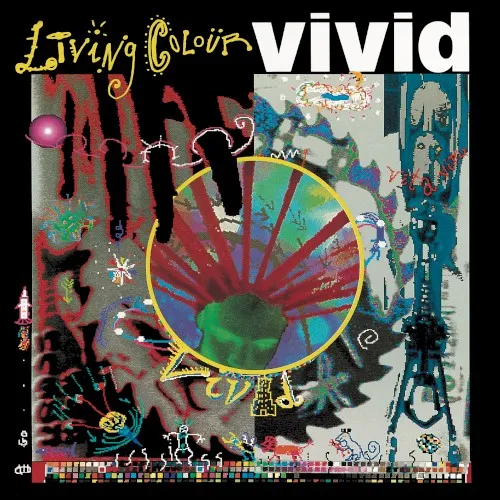
Vivid
Living Colour
Vivid succeeds not by blending its styles into one smooth genre but by keeping their seams audible, using accessible songs to carry unresolved musical and social tension.
AI-assisted, human-reviewed
A debut too broad for one shelf
The first voice on Vivid is not Corey Glover’s. A sample of Malcolm X opens “Cult of Personality,” placing a public speech before Vernon Reid’s guitar riff and the band’s major-label debut. The sequence is compact but demanding: historical authority, a hook made for rock radio, and a warning about authority itself arrive within seconds.
Living Colour spends the rest of the album refusing the idea that this combination needs to become a single genre. Hard-rock weight, funk rhythm, gospel projection, hip-hop guest voices, post-punk unease, and polished pop choruses keep their own outlines. Vivid works because those outlines rub against one another. Its crossover is not a neutral mixture. It is the sound of four Black musicians claiming the full vocabulary of rock while showing how narrowly the industry had defined who could use it.
The band’s route to Epic underlines that pressure. Reid had already helped found the Black Rock Coalition when Mick Jagger’s support gave Living Colour access to studio time and a label hearing. Jagger produced the early recordings of “Glamour Boys” and “Which Way to America”; Ed Stasium produced most of the album. The resulting sheen creates access, but the performances keep placing rough information inside it.
The rhythm section keeps the range coherent
Reid is the obvious source of surprise: his guitar can move from a compressed funk chop to a broad metal chord, then abandon both for a fast, dissonant run. Muzz Skillings and Will Calhoun keep those changes from becoming a guitarist’s portfolio. Skillings treats the bass as both anchor and counterline, while Calhoun can make a straight rock beat swing or push a groove toward double time without changing the band’s identity.
“Desperate People”: force keeps changing hands
“Desperate People” begins with weight but refuses to leave it in one place. The guitar riff descends in thick blocks; bass and drums answer with a more elastic movement beneath it. Glover alternates between controlled lines and a rasp that strains at the top of his range. When the arrangement opens, Reid’s guitar does not simply solo over the same base. The rhythm section changes the amount of space around him, making the virtuosity feel like part of the song’s instability.
The rhythm section lets the album change style without splintering. “I Want to Know” uses brighter choruses and a tidier pop-rock frame. “Broken Hearts” moves toward a lighter, narrative groove. Neither sounds like an unrelated exercise because Calhoun and Skillings preserve the same alert relationship between pocket and interruption.
The hit makes virtuosity serve a warning
“Cult of Personality” became the album’s public identity, but its construction resists the usual separation between message and display. Glover brought the germ of the riff into a rehearsal; Reid, Skillings, and Calhoun developed it collectively. That origin can be heard in the way the part behaves. It is catchy without sitting comfortably under the vocal. Its accents keep the verse slightly unsettled.
“Cult of Personality”: the riff becomes a trap
The main figure returns often enough to promise certainty, while the lyric examines the danger of granting certainty to charismatic leaders. Glover sings with clean, theatrical projection rather than a detached sneer. He makes the warning attractive. The chorus widens into an arena-sized hook, then Reid’s solo tears at the frame with clipped bursts, sharp register jumps, and phrases that refuse a singable resolution.
This is not decoration after the argument. The solo demonstrates the unease the chorus temporarily contains. Calhoun’s final move into a faster drive makes the track feel as if its own momentum has escaped supervision. Vivid gets a difficult idea onto mainstream radio by making seduction and mistrust audible at the same time.
The city enters through changing arrangements
The middle of the album narrows its attention from public figures to neighborhood life and everyday racial suspicion. Living Colour does not give those subjects one official protest sound. “Open Letter (To a Landlord)” expands from a reflective opening into hard-rock pressure. “Funny Vibe” answers fear with a groove whose wit never cancels its anger.
“Open Letter (To a Landlord)”: the ballad frame breaks open
Reid and poet Tracie Morris shape the song around threatened community rather than private heartbreak. The arrangement initially borrows the space of a power ballad: clean guitar, measured vocal, and room for the words to lead. When the band enters at full weight, the change is not an obligatory loud chorus. Distorted chords turn the appeal outward, and Glover’s delivery moves from testimony toward confrontation.
The production makes every stage legible, perhaps too legible. Reverb and polished guitar layers place the song within late-eighties rock radio, but the escalation still changes who seems to be addressed. What begins as memory becomes a public demand.
“Funny Vibe”: suspicion gets a crooked groove
“Funny Vibe” starts from an experience Reid described: a white woman clutching her bag when he entered an elevator. The music refuses solemnity. Skillings supplies an agile funk line, the band inserts abrupt heavy accents, and guest voices from Chuck D and Flavor Flav widen the track’s social field. Glover’s repeated reassurance grows more pointed each time the arrangement contradicts it with another jolt.
The track’s humor is structural. A lighter pocket invites movement, then guitar and voice expose the fear underneath the encounter. Rather than smoothing funk and metal into a new formula, Living Colour lets each style comment on the other.
Polish opens doors and smooths some edges
Vivid needed no lesson in range, but it occasionally mistakes range for development. “Glamour Boys” is nimble and sharply arranged, with a chorus that places satire inside a bright pop surface. “What’s Your Favorite Color?” turns the band’s name into a playful theme. In sequence, however, those gestures can feel like proof that Living Colour can occupy every available room rather than pressure each room from within.
The production shares that tension. Stasium gives the drums impact, keeps Glover’s voice forward, and separates Reid’s dense guitar layers. The same clarity sometimes rounds off the rhythmic abrasion. Snare ambience and processed guitar color identify the period even when the playing pushes beyond it. “I Want to Know” is the clearest case: its melodic directness is real, but the smooth frame makes the band’s internal friction less audible.
The Talking Heads cover “Memories Can’t Wait” shows a stronger use of polish. Living Colour keeps the song’s nervous circularity while making the guitar heavier and the vocal more physically present. The cover does not serve as a tasteful influence marker. It tests whether post-punk tension can survive the band’s larger attack, and mostly does.
America remains split at the exit
The closing “Which Way to America” returns to the hardest edge of the record. Its riff is less instantly rounded than “Cult of Personality,” and Glover delivers the gap between national promise and lived access without offering a consoling refrain. Jagger’s earlier production gives the track a broad rock surface, but the band’s attack keeps that surface from reading as endorsement.
Ending there changes the function of the album’s variety. The pop choruses, funk pockets, metal weight, and comic theme song have not demonstrated a country or an industry made whole by crossover. They have shown how much musical territory Living Colour can occupy while the social borders around that territory remain in place.
Vivid is strongest when its seams stay exposed. Calhoun and Skillings make the turns coherent; Reid makes them unstable; Glover gives each change a human scale. The moments that sound dated are generally those where access wins too cleanly and the record settles into familiar radio polish. The sharper songs invite the listener through a recognizable form, then reveal the argument that form was carrying.
Strengths and limits
Strengths
- The rhythm section makes sharp stylistic changes feel like one band's decisions.
- Hooks and virtuosity carry political tension without reducing it to slogans.
Limits
- Glossy late-eighties production softens some of the band's rhythmic abrasion.
- The broad stylistic range occasionally feels like a demonstration of capability.
Further reading: Tracie Morris interviews Vernon Reid for BOMB
Sources
- Vivid release group and editions, MusicBrainz. Accessed August 20, 2026.
- Vivid catalog record, track listing, personnel, and production credits, Rock and Roll Hall of Fame Library and Archives. Accessed August 20, 2026.
- Vernon Reid talks Cult of Personality, Guitar Player. Accessed August 20, 2026.
- Living Colour's track-by-track guide to Vivid, Kerrang!. Accessed August 20, 2026.
- Living Colour: Vivid album review, Pitchfork. Accessed August 20, 2026.
Album artwork remains the property of its respective rights holders. It is reproduced at limited resolution on this review page for identification and critical context.