 Reviews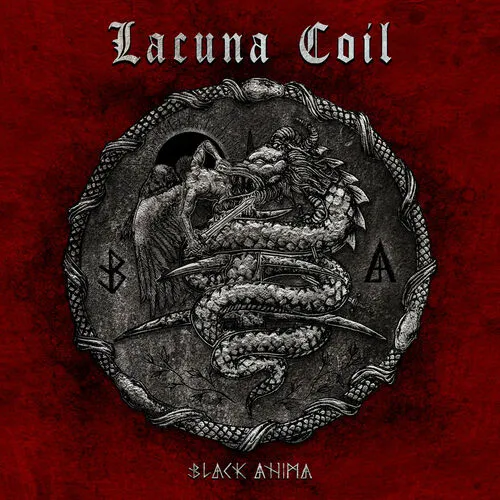
Full Review
AI-assisted, human-reviewed
Black Anima
Lacuna Coil
Black Anima gives grief force by making Cristina Scabbia and Andrea Ferro occupy different emotional positions; it narrows when that contrast settles into a predictable exchange over uniformly heavy riffs.
Grief given a heavy frame
The 11-track standard edition of Black Anima begins with “Anima Nera,” a two-and-a-half- minute prologue of distant voices, electronics, and gathering pressure. “Sword of Anger” then replaces suggestion with a low, percussive guitar figure and Andrea Ferro’s harsh lead. Cristina Scabbia does not simply soften the impact when she enters. Her clearer melody changes the distance from which the same darkness is heard.
Across the album, Ferro often sounds inside the immediate force of anger or panic. Scabbia can stand within that force, answer it, or observe what remains after it passes. Lacuna Coil has long been identified by two lead voices, but Black Anima works best when the difference affects structure rather than reproducing a familiar harsh-verse, clean-chorus division.
The record grew out of several deaths close to the band, including the loss of both of Scabbia’s parents within months. Andrea Ferro described the concept as learning to direct energy through events that cannot be controlled. That context matters, but the album cannot rely on biography to make every heavy gesture meaningful. Its strongest songs turn grief into timing, register, and vocal relation. Its weaker passages settle for weight as proof of seriousness.
The dual voice rebuilt for 2019
Marco Coti Zelati produced Black Anima and recorded it at BRX Studio in Milan. Marco Barusso mixed the album there, and Marco D’Agostino mastered it at 96kHz Mastering Studio. The production places guitars and bass in a dense low block while preserving a separate space for electronics, choral textures, and the two singers. The sound is polished, but its edges remain deliberate.
The album continues the heavier direction of 2016’s Delirium. Guitar parts favor syncopated, palm-muted patterns and short bursts of movement over the more open gothic rock language associated with parts of Lacuna Coil’s earlier catalog. The rhythm section often treats the riff as percussion. Keyboards do important atmospheric work around that impact, especially in introductions and transitions.
Ferro’s vocal approach has also changed from the restrained male countervoice heard on the band’s early records. His growls now carry entire sections with a coarse, compressed force. Scabbia answers with sustained melodic lines whose clarity is heightened by the low instrumental register. The opposition is effective because neither voice belongs exclusively to aggression or beauty. On the better tracks, each singer can sound wounded, commanding, or detached.
The prologue and closing title track frame the album as a passage through a dark soul. Ferro’s account of the record as a book of presences gives that shape a documented conceptual basis. Within the sequence, however, the individual chapters are linked more by atmosphere and recurring vocal roles than by a legible narrative.
Four points where darkness takes shape
Sword of Anger: The body arrives before the explanation
After the suspended prologue, “Sword of Anger” lands on a riff whose low notes function almost like additional kick drums. Ferro enters close to the instrumental attack. His phrases are short and forceful, keeping the verse physically compressed.
Scabbia’s chorus widens the melodic range without removing the pressure underneath. The contrast makes anger sound less stable, as if the song can feel the cost of its own forward motion. Repeated exchanges retain their effect because the arrangement changes space around the voices instead of simply alternating them.
Layers of Time: Two singers share one acceleration
“Layers of Time” starts quickly and keeps its guitar figure in tight rhythmic relation with the drums. Ferro’s opening is urgent, while Scabbia’s refrain lengthens the vocal line across the same pulse. The chorus feels larger because of duration and register, not because the band abandons the riff.
Electronic color sits behind the guitars, the rhythm remains sharply defined, and the vocal handoff turns a compact arrangement into a change of perspective. Once the chorus has established the pattern, however, later returns confirm rather than deepen it.
Under the Surface: Melody carries the concealed pressure
“Under the Surface” gives Scabbia more sustained control. The verse leaves pockets around her lead, and the chorus uses a direct melodic rise instead of competing with the low guitar mass. Ferro’s presence feels like pressure entering from the edge rather than a required counterweight.
The track reduces blunt impact without becoming a separate ballad, giving the sequence a different pace. It also exposes how conventional some melodic resolutions can be. Scabbia gives the chorus emotional precision, but the chord movement reaches a familiar uplift that the surrounding unease has not fully earned.
Veneficium: Ritual atmosphere changes the scale
At more than six minutes, “Veneficium” has room to let sound gather. Choral and keyboard textures create a ceremonial space before the full band establishes a slow, heavy pulse. Scabbia’s longer lines move above it while Ferro enters as a disruptive force rather than the automatic owner of the verse.
The track’s scale is justified by changes in density. Sections recede enough for the next entrance to carry consequence, and the vocal contrast grows more complicated as the song continues. Instead of assigning light and dark to fixed singers, the arrangement lets both voices approach threat and mourning from different angles. The album’s concept becomes audible here without requiring an explanation.
Contrast with real consequence
Scabbia and Ferro remain recognizable individuals throughout the production. Their voices are not blended into a generic wall, and the songs can change direction through a vocal entrance before the instruments move. That independence gives familiar verse-chorus forms more dramatic information.
Coti Zelati’s production also keeps the low register readable. Guitar and bass create mass, but kick patterns, electronic pulses, and vocal consonants still mark the surface. The record can sound dense without becoming indistinct. “Reckless” and “Apocalypse” both benefit from that separation, particularly when melodic phrases cut through arrangements that remain rhythmically severe.
The album’s grief is strongest when restraint follows impact. Small electronic tails, brief withdrawals of guitar, and the prologue’s suspended space make heaviness measurable. Without those contrasts, the record would confuse pressure with depth.
Where weight becomes uniform
Several middle tracks rely on closely related low, syncopated guitar shapes. “Now or Never,” “Under the Surface,” and “The End Is All I Can See” contain different vocal melodies, but their physical foundations can feel interchangeable in sequence. The production preserves detail inside each song while the album-level contour flattens.
The two-singer format sometimes hardens into expectation. A harsh entrance followed by a clean melodic opening remains effective, yet repetition turns perspective into allocation: Ferro supplies impact, Scabbia supplies expansion. “Veneficium” is so persuasive partly because it complicates those jobs.
The conceptual frame has a similar gap. The prologue, title, artwork, and interviews define a book of presences shaped by loss. Individual lyrics communicate anger, endurance, and mortality, but the sequence does not always reveal how one chapter changes the next. The record carries a coherent emotional climate more clearly than a developing journey.
The soul returns altered
Black Anima does not ask grief to become quiet or tasteful. It gives loss a physical frame and trusts two very different voices to test that frame from within. The result is most convincing when a vocal change alters the listener’s position or when an electronic withdrawal makes the next riff heavier. Repeated low patterns and predictable handoffs occasionally narrow that range. The closing title track returns to the suspended world of the prologue with more weight around it, leaving the album’s darkness present rather than resolved.
The argument
Strengths and limits
Strengths
- The two lead voices change perspective as well as texture.
- Electronic and choral details give the low guitar writing depth and atmosphere.
Limits
- Similar low-register riffs make several middle tracks share one physical profile.
- The conceptual frame is clearer in interviews and artwork than in every individual song.
Documentation
Sources
- Black Anima tracklist and production credits, Lacuna Coil. Accessed July 26, 2026.
- Black Anima release group and standard edition, MusicBrainz. Accessed July 26, 2026.
- Andrea Ferro on the spirit and losses behind Black Anima, Rolling Stone Italia. Accessed July 26, 2026.
- Album review of Lacuna Coil's Black Anima, Kerrang!. Accessed July 26, 2026.
Album artwork remains the property of its respective rights holders. It is reproduced at limited resolution on this review page for identification and critical context.