 Reviews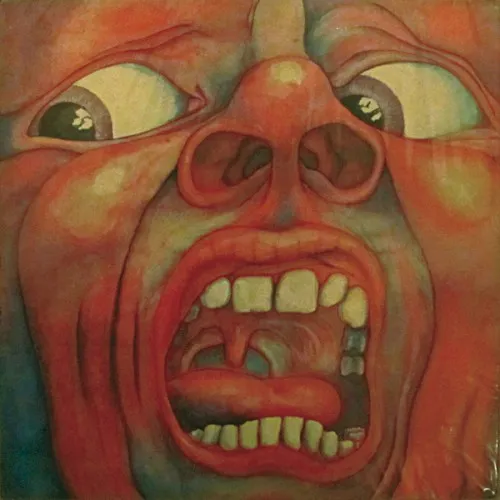
In the Court of the Crimson King
King Crimson
Each piece on In the Court of the Crimson King changes the apparent size of the band, turning density, distance, and silence into structural events.
AI-assisted, human-reviewed
Five pieces keep changing the size of the band
In the Court of the Crimson King announces itself with mass: an abrasive guitar sound, alto saxophone, bass, and drums appear to strike as one body. Forty-four minutes later, the record ends amid a Mellotron procession, a pause, and the strange afterimage of a studio organ. Between those points, the same five musicians can resemble a jazz group, a folk ensemble, an orchestra, or a handful of players listening for the next small sound.
King Crimson orders that range so each track corrects the listener’s estimate of what the band can contain. The force of “21st Century Schizoid Man” makes the quiet entrance of “I Talk to the Wind” feel physically smaller. “Epitaph” enlarges that room with sustained Mellotron chords. “Moonchild” then removes weight until individual taps and guitar notes seem far apart. The title track can sound monumental because the album has first made near-silence part of its scale.
The debut was recorded on eight-track tape at Wessex Studios after the group abandoned an attempt with an outside producer and took control of the sessions. That constraint helps explain its clarity. The arrangements do not achieve size by keeping every instrument active. They decide which player defines the room at each moment.
Schizoid Man compresses five players into one attack
The opening track’s distortion is not a blanket laid across an ordinary rock performance. Greg Lake’s treated vocal, Robert Fripp’s guitar, Ian McDonald’s alto saxophone, and the rhythm section all favor hard edges. Yet the sound remains readable because the band moves between roles rather than occupying a constant wall. The main riff hits in clipped bursts. Space around those bursts makes each return feel heavier.
Michael Giles is central to that effect. His drumming does not merely reinforce the riff. Fills run across its boundaries, cymbal accents alter its balance, and the fast middle passage gains momentum without settling into a flat pulse. Lake’s bass often locks with the line while Giles keeps questioning where its weight should fall.
“21st Century Schizoid Man”: unison creates pressure
During the instrumental section, saxophone and guitar converge on rapid figures before separating into solos. The unisons sound severe because their precision is temporary. They narrow the ensemble into a single line, then release individual timbres back into the mix. Fripp’s guitar cuts with a compact, dry edge; McDonald’s saxophone is more breathy and volatile. The track’s violence comes from forcing those identities together, not from erasing their difference.
This opening also establishes a risk the album does not always avoid. Peter Sinfield’s images of political and technological damage arrive as compressed emblems rather than a developed scene. Lake’s distorted delivery makes that abstraction effective here. Later, similar symbols can feel like a ready-made language of doom.
I Talk to the Wind brings every edge closer
The second track offers relief by changing the apparent distance between performer and listener. Lake drops the vocal treatment and sings with little force. McDonald’s flute enters as a line with breath around it, while Giles reduces his kit to soft touches and small cymbal colors. After the opening track’s collective blows, these sounds seem close enough to inspect.
The arrangement is gentle without becoming static. Flute phrases answer the vocal rather than coating it, and the bass gives the harmony a firm floor at low volume. Giles’s fills still move across the bar, but their reduced weight makes timing more exposed. The band is not demonstrating a second genre for contrast. It is showing that its internal coordination survives when force can no longer hide a loose entrance.
The sequencing changes the meaning of both songs. “Schizoid Man” now sounds like one extreme available to the group, not its natural setting. “I Talk to the Wind” gains tension because the first track has taught the listener what these players can do when they close the space between them.
Epitaph makes sustained sound move
“Epitaph” expands the intimate scale without returning to the opener’s abrasion. Its Mellotron chords imitate orchestral strings, but their importance lies in motion inside the sustain. McDonald later described riding the levels of two Mellotron tracks against each other during the original mix. The result is a background that swells and recedes even when the harmony remains in place.
“Epitaph”: the orchestra breathes through the mix
Lake sings long, controlled lines over acoustic guitar and bass while Giles delays the full weight of the drums. When the percussion and Mellotron rise together, the song seems to widen behind the voice. It is a studio construction, yet it preserves the sensation of an ensemble responding in real time.
The track also exposes the limit of Sinfield’s writing more clearly than “Schizoid Man.” Images of walls, fate, knowledge, and confusion create a consistent atmosphere, but they do not always sharpen one another. The arrangement supplies the development the words sometimes lack. Repeated harmonic material changes function as its density changes: first support, then warning, then something close to collapse.
Moonchild lets the frame almost disappear
The sung opening of “Moonchild” reduces the ensemble further. Guitar figures leave wide gaps, cymbals shimmer at the edge of audibility, and Lake’s voice avoids the projection he used on “Epitaph.” After roughly two and a half minutes, the composed song gives way to “The Illusion,” an extended collective improvisation built from isolated guitar notes, vibraphone, percussion, and silence.
“Moonchild”: attention replaces momentum
At its best, the improvisation changes the listener’s unit of measurement. A quiet tap matters because nothing masks its decay. One player proposes a gesture, and the others leave room around it rather than turning it into a jam over fixed chords. This is the album’s smallest version of King Crimson: not a powerful group holding back, but a social process made audible.
The passage also runs beyond the tension it creates. Its gestures become so sparse that the distinction between patient listening and lost momentum narrows. “Moonchild” proves that the album can make silence structural, but it spends too long proving the point. The finale benefits from the cleared space even as the route there becomes diffuse.
The court rebuilds grandeur one layer at a time
The closing title track begins with acoustic guitar and flute before Mellotron, bass, drums, and layered voices establish its processional refrain. Unlike “Epitaph,” which grows through continuous pressure, “The Court of the Crimson King” works by return. Each verse and instrumental passage withdraws part of the mass, allowing the refrain to arrive again at full scale.
“The Court of the Crimson King”: repetition earns the monument
McDonald’s Mellotron supplies the apparent orchestra, but Giles prevents ceremony from becoming rigid. His fills push against the stately pace, and the flute passage opens a smaller chamber inside the arrangement. The final repetitions are therefore not simple inflation. The track keeps displaying the human ensemble within the monument it has built.
Its long pieces and symbolic lyrics helped provide a vocabulary for progressive rock. Within the record, control of proportion holds that vocabulary together. A riff can make five players sound like one machine. A flute can pull them back into a room. Two Mellotron tracks can suggest an orchestra while a nearly empty improvisation makes one cymbal touch carry the form. In the Court of the Crimson King is convincing when those changes of scale alter how the next sound is heard. It falters when space becomes an end in itself, then recovers by showing exactly how much architecture can rise from the silence.
Strengths and limits
Strengths
- Extreme dynamic changes remain legible because each player has a distinct function.
- Mellotron, woodwinds, guitar, and percussion alter the music's scale without breaking its sequence.
Limits
- Moonchild's extended free improvisation lets attention dissipate before the finale.
- Peter Sinfield's symbolic language sometimes turns specific fears into generalized portent.
Further reading: King Crimson explain how they made the album
Sources
- In the Court of the Crimson King release group, MusicBrainz. Accessed August 13, 2026.
- In The Court, DGM Live. Accessed August 13, 2026.
- In the Court of Ian McDonald, Sound & Vision. Accessed August 13, 2026.
Album artwork remains the property of its respective rights holders. It is reproduced at limited resolution on this review page for identification and critical context.