 Reviews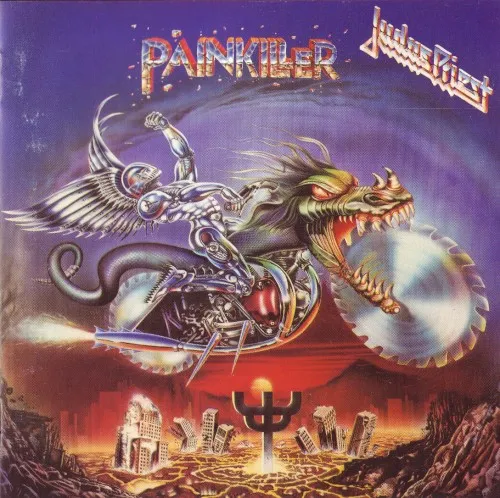
Full Review
AI-assisted, human-reviewed
Painkiller
Judas Priest
Painkiller renews Judas Priest without reinvention, pushing the band's established heavy-metal language until tradition sounds newly dangerous.
A drum fill redraws the border
Painkiller announces its renewal before a guitar plays. Scott Travis opens with rapid double kick, hard snare accents, and a tom pattern that sounds both athletic and exact. When Glenn Tipton and K.K. Downing enter, Judas Priest’s familiar materials—twin guitars, high-register vocals, compact riffs—have acquired a different engine.
The album arrived after Turbo and Ram It Down, records that had stretched Priest toward synthesisers and polished arena metal. Painkiller does not abandon the band’s language. It compresses and accelerates it until heavy-metal tradition meets the extremity developing around it.
The renewal goes beyond added weight. By 1990, thrash and death metal had already moved the genre’s thresholds of speed, abrasion, and rhythmic complexity. Priest keeps clear choruses, fantastical narrative, paired leads, and Halford’s theatrical diction, then subjects those features to pressure they had not previously carried together.
Five players, newly balanced
Travis’s first studio album with Priest changes more than tempo. His kick drums can double the guitar pulse, break away from it, or create a continuous floor beneath slower chords. Ian Hill keeps the bass focused on structural weight. That division leaves Tipton and Downing free to separate rhythm, harmony, and lead lines without thinning the attack.
Chris Tsangarides co-produced with the band. The recording is bright and tightly bounded: cymbals cut high, guitars occupy distinct sides, and Rob Halford’s voice rises above them without losing consonants. Precision makes the density readable. The songs sound extreme not because everything blurs, but because several forceful parts remain individually clear.
The band recorded the core performances with limited overdubbing, reserving heavier studio construction chiefly for “Night Crawler” and “A Touch of Evil.” That decision can be heard in the rhythm guitars: they have enough width to hit as a wall, yet changes in picking and muting remain exposed. Travis does not sound pasted beneath an older Priest arrangement. The other players leave him structural space, and the new balance changes how every familiar device lands.
Extremity in three forms
Painkiller: Speed with internal landmarks
The title track could be shapeless at its velocity. Instead, it supplies landmarks: the isolated drum entrance, a descending guitar answer, a verse riff with sharply placed gaps, and a chorus that widens into longer notes. Halford moves from a metallic upper register to an even higher scream, but his rhythm stays locked to the consonants. The guitar solos accelerate and then hand the song back to its central figure. Virtuosity serves orientation.
The arrangement also understands suspense. Before Tipton’s extended solo, the band pulls back enough to let a rising, swept figure reset the ear. The solo then develops in phrases rather than arriving as one continuous display: fast scalar motion, held notes, and bends with distinct destinations. When the central riff returns, it feels recovered rather than merely repeated.
Night Crawler: Restraint creates the monster
“Night Crawler” proves the record can build menace without constant speed. A stalking riff leaves room after each phrase; low keyboard colour and layered vocals enlarge the negative space. The quieter middle passage reduces the band to a narrated threat before the chorus returns with greater weight. The creature in the lyric is conventional, but the arrangement makes anticipation, rather than description, the source of fear.
A Touch of Evil: Melody against the machine
The album’s most pronounced production piece begins with synthesisers and a measured guitar line. Travis holds back, allowing Halford to use a rounder middle register before the chorus climbs. Tipton’s solo is melodic and sustained rather than a race through subdivisions. Placed amid faster songs, “A Touch of Evil” reveals that the band’s renewal depends on contrast even when the broader album advertises relentlessness.
Halford’s lower register is essential here. The album’s reputation rests on his highest notes, but “A Touch of Evil” gains tension because he withholds them. He shapes the verse in longer, darker phrases, making the chorus’s ascent a dramatic choice. Range becomes storytelling rather than a measurement.
Twin guitars keep their identities
Priest’s two-guitar tradition is easy to describe and harder to preserve at this density. “All Guns Blazing” lets the guitars strike together, then separates them into answering leads. “Metal Meltdown” uses a noisy solo introduction before settling into a riff that alternates open-string drive with climbing shapes. The stereo field allows those movements to register as conversation rather than overdubbed mass.
“Hell Patrol” shows the pair working with restraint. Its central riff advances in measured blocks, leaving Travis to animate the space underneath, while small lead answers brighten the edges. On “Leather Rebel,” tightly synchronised picking produces the opposite effect: guitars and drums fuse into one narrow path. The contrast between those songs is not one of speed alone, but of how much independence the players retain inside the beat.
Halford works in the same way. His screams provide the record’s headline extremity, but his lower phrases give choruses contour. On “Between the Hammer & the Anvil,” the melody rides across the riff instead of merely matching it. Voice and guitars compete for height while the rhythm section keeps the ground fixed.
Maximum force has diminishing returns
The album’s middle run demonstrates the cost of its chosen intensity. “Hell Patrol,” “All Guns Blazing,” “Leather Rebel,” and “Metal Meltdown” arrive with related tempos, bright guitar tones, and martial or apocalyptic imagery. Each contains deft changes, yet the sequence gives those differences little breathing room. What is startling in the opener becomes the normal operating level.
The lyrics often function as aerodynamic surfaces for Halford’s delivery. Metal messiahs, night creatures, rebels, and armed patrols suit the music’s scale, but several remain emblems rather than characters. “A Touch of Evil” gains depth from uncertainty and desire; the more literal battle songs rarely seek that ambiguity.
The production’s clarity can compound the fatigue. Because each cymbal, kick, and doubled guitar arrives with a hard edge, there is little atmospheric blur in which the ear can rest. “Night Crawler” and “A Touch of Evil” change the album’s depth as well as its tempo: for a few minutes, sounds can recede, wait, and imply something beyond the front line.
The old grammar survives the impact
“Battle Hymn” and “One Shot at Glory” close the album by converting its velocity into ceremony. The instrumental prelude gives the guitars a brief, stately frame; the finale then restores the gallop and stacked chorus. It is triumphal without pretending the band has become someone else.
The finale also redistributes the virtuosity heard at the start. Rather than opening with an individual player’s shock entrance, it builds toward ensemble declarations and harmonised leads. Travis still drives hard, but the song presents speed as collective momentum. The sequence has moved from the impossible machine of “Painkiller” to musicians making an old metal promise together.
Judas Priest responds to metal’s rising thresholds of speed and aggression by finding unused pressure inside its own grammar. Travis redraws the rhythmic border, while twin leads, theatrical narrative, and Halford’s command remain intact. The band drives its tradition to the point where survival is no longer guaranteed.
The argument
Strengths and limits
Strengths
- Scott Travis's drumming changes the band's sense of speed without obscuring the riffs.
- The twin guitars preserve distinct melodic roles inside unusually dense arrangements.
Limits
- Sustained maximum intensity leaves the middle sequence with limited dynamic space.
- Several fantasy narratives function as vehicles for attack rather than developed songs.
Further reading: Judas Priest official discography
Documentation
Sources
- Painkiller official discography entry, Judas Priest. Accessed August 7, 2026.
- Painkiller UK release and credits, MusicBrainz. Accessed August 7, 2026.
- Judas Priest discuss the making of Painkiller, Louder. Accessed August 7, 2026.
Album artwork remains the property of its respective rights holders. It is reproduced at limited resolution on this review page for identification and critical context.