 Reviews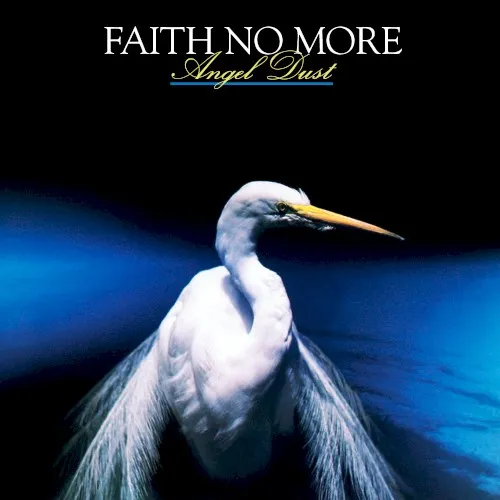
Full Review
AI-assisted, human-reviewed
Angel Dust
Faith No More
Angel Dust organizes apparent chaos through rhythm and vocal character, making each stylistic rupture feel like another form of control.
Disorder under command
“Land of Sunshine” begins with Billy Gould’s bass and Mike Bordin’s drums behaving as if the song will remain a hard funk exercise. Jim Martin’s guitar adds blunt weight. Then Mike Patton enters with the smile of a motivational speaker whose advice has become a threat. His diction is clean, his pitch exaggerated, and his breaths sound placed rather than spontaneous.
Patton’s performance helps Angel Dust hold together through its abrupt turns. The album moves through metal, lounge music, hardcore, theatrical pop, and soundtrack instrumentals, but it is rarely uncontrolled. Gould and Bordin set exact physical terms; Roddy Bottum’s keyboards alter the room; Martin’s guitar supplies friction; Patton assigns each section a character who wants something from the listener.
The record’s grotesque quality comes from discipline. Familiar voices of confidence, desire, and reassurance are pushed until their need for control becomes audible.
The difficult follow-up
Angel Dust followed the commercial reach of The Real Thing and was the first Faith No More album on which Patton participated substantially in the writing. The original thirteen-track edition was released by Slash and Reprise on June 8, 1992. The band and Matt Wallace produced it, recording at Coast Recorders and Brilliant Studios in San Francisco.
The lineup’s internal differences became part of the music. Gould, Bordin, Bottum, and Patton pursued arrangements that could change style without warning, while Martin’s guitar often sounds like a resistant block inside them. That friction complicates a clean story of reinvention. The metal riffing becomes one voice among keyboards, samples, bass-led grooves, and tightly arranged vocal scenes.
Current digital editions commonly append the Commodores cover “Easy.” This review treats “Midnight Cowboy” as the close of the original thirteen-track CD sequence. The distinction matters because the instrumental ends the album by withdrawing language, not by adding a knowing encore.
Four scenes of managed instability
Caffeine: Repetition tightens the room
“Caffeine” builds pressure from a bass figure and drum pattern that refuse to settle into an easy backbeat. Martin’s guitar attacks in short blocks, while Bottum’s keyboard adds an industrial glare around the riff. Patton moves from clipped speech to a strained upper register without presenting either as the natural voice of the song.
The arrangement does not chase complexity through constant new material. It repeats until the room feels smaller. Changes in vocal register and guitar density make the same pulse more oppressive. This is the album’s control principle in its least comic form.
Midlife Crisis: A loop becomes a trap
The opening drum loop gives “Midlife Crisis” a mechanical steadiness, but Gould’s bass keeps nudging against it. Patton delivers the verse in a low, measured register, then opens the chorus into a broader melody that sounds triumphant only from a distance. Bottum’s keyboard line brightens the surface without resolving the tension underneath.
The song is accessible because every layer has a legible job. It is unsettling because those jobs do not agree. Rhythm promises continuity, the chorus promises release, and the voice treats both promises with suspicion.
RV: The powerless man controls the monologue
“RV” removes the band’s usual attack. Piano, restrained bass, and a dragging beat support Patton’s nasal portrait of a man sunk into his chair and his resentments. The vocal is a caricature, but the arrangement gives it patience. No loud chorus arrives to tell the listener how to judge him.
That refusal makes the track more than comic relief. The character has little social power, yet he controls the room by refusing movement. When the band finally increases the pressure, the shift exposes the aggression already present in the quieter delivery.
A Small Victory: Precision makes optimism suspicious
Handclap-like percussion, bright keyboards, and a sharply articulated bass line give “A Small Victory” forward motion. Patton’s melody is one of the album’s most open, but the phrasing remains stiff enough to resist uncomplicated uplift. Each syllable sounds inspected before it leaves his mouth.
The track shows how the band can use polish without becoming reassuring. Its parts are cleaner than those of “Caffeine,” yet their exact alignment feels ceremonial. The victory in the title is bounded and provisional; the arrangement keeps measuring it.
A rhythm section that permits excess
Gould and Bordin make the album’s range credible. The bass often carries the identifiable shape of a song while guitar and keyboards change its surface. Bordin can make a loop feel physical, hold a slow character piece together, or drive a heavy section without flattening its syncopation. Their precision lets the record cut between styles without losing its body.
Patton’s vocal control supplies the other continuity. He does not simply demonstrate a large range. He chooses social voices: salesman, scold, crooner, patient, braggart. The changes reveal how performance can turn authority into panic. Bottum’s keyboards sharpen that effect by invoking familiar spaces, from arena sheen to television comfort, then making them slightly hostile.
Caricature can close the question
The same theatrical method sometimes reaches its conclusion too quickly. “Be Aggressive” is arranged with memorable choral force, but its provocation can dominate the musical development. Once the joke and its target are clear, repetition adds scale more readily than ambiguity.
“Malpractice” pushes fragmentation further, placing violent ensemble blocks beside sampled and orchestral color. Its instability suits the album, though some transitions register as interruption before they become composition. The record’s control is never in doubt; the reason for a particular collision is occasionally thinner.
The cover of John Barry’s “Midnight Cowboy” provides an elegant exit, but elegance is also its limitation. After an album that makes reassurance suspect, the instrumental closes the door with unusual neatness.
The mechanism remains exposed
Angel Dust holds together because the band gives every rupture a frame. Bass and drums define the floor, keyboards change the setting, guitar pushes against the arrangement, and Patton decides which unreliable person is speaking.
Some characters become cartoons, and a few collisions advertise difference more clearly than they develop it. The stronger songs keep their mechanism exposed. They allow the listener to hear discipline producing disgust, humor, and unease at the same time. What first resembles chaos is a band tightening its grip.
The argument
Strengths and limits
Strengths
- Billy Gould and Mike Bordin give abrupt stylistic changes a precise rhythmic frame.
- Mike Patton uses distinct vocal characters to expose authority, vanity, and panic.
Limits
- A few genre turns depend more on caricature than on development.
- The closing instrumental releases tension neatly but simplifies the album's harsher ambiguities.
Further reading: Angel Dust original release record
Documentation
Sources
- Angel Dust original release and track listing, MusicBrainz. Accessed July 28, 2026.
- Faith No More official discography, Faith No More. Accessed August 7, 2026.
- Mike Bordin and Billy Gould revisit the making of Angel Dust, Metal Hammer. Accessed July 28, 2026.
- Faith No More revisit Angel Dust at 30, Consequence. Accessed August 7, 2026.
Album artwork remains the property of its respective rights holders. It is reproduced at limited resolution on this review page for identification and critical context.