 Reviews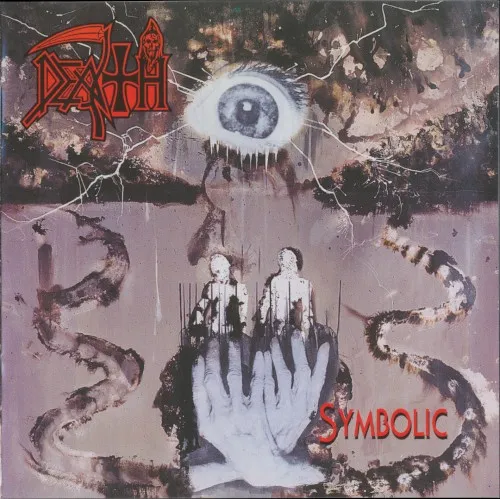
Full Review
AI-assisted, human-reviewed
Symbolic
Death
Symbolic uses precise riffs, accents, and melodic returns to keep aggression changing shape without losing the identity of each part.
Precision without containment
By 1995, Chuck Schuldiner had already spent several Death albums pulling his writing away from the blunt shock of the band’s early work. Human accelerated that change with jazz-aware players and tightly folded meters; Individual Thought Patterns made the music even more restless. Symbolic keeps that velocity and technical reach while making their internal logic easier to hear.
That clarity is not a bid for politeness. The guitars remain dry and abrasive, Gene Hoglan’s double-kick patterns press hard against the songs, and Schuldiner’s voice still arrives as a high, torn rasp. What changes is the amount of air around each decision. A riff can finish its thought before the next one interrupts. A cymbal accent can identify the hinge between two meters. A melodic line can return without being treated as relief from the heavy material.
Precision creates movement rather than enclosure. The parts are exact enough to be remembered, so their reappearance carries meaning. When a figure returns faster, higher, or under a different drum pattern, complexity becomes audible change. That makes Symbolic unusually consistent with its lyrics, which leave fantasy violence behind for memory, surveillance, judgment, and the fear of becoming fixed.
Morrisound lets the joins show
Jim Morris produced and engineered the album at Morrisound Recording in Tampa, with Schuldiner as co-producer. The location ties Symbolic to Florida death metal, but the sound does not pursue the scene’s most claustrophobic extreme. Guitars occupy a hard central band; the kick drums are articulate without swallowing the bass; cymbals preserve their separate colors. Even fast passages leave enough transient detail to reveal who is moving the song.
Schuldiner recorded the rhythm guitars, while Bobby Koelble was given room to shape his own solos. That division matters. The rhythm tracks establish a single, disciplined grammar: compact downstrokes, ringing intervals, and melodic fragments that can be shifted without losing identity. Koelble’s leads then loosen the grid. His bends and longer phrases often cross the bar line instead of underlining it, briefly replacing the music’s clipped syntax with a more vocal one.
Kelly Conlon’s bass is less independent than Steve Di Giorgio’s playing on the previous album, but the apparent reduction serves the new design. He reinforces the guitar pivots and gives Hoglan a stable floor. The trade-off is audible: listeners looking for a second melodic argument in the low register may find the bass too obedient. The gain is a record whose complicated forms can be followed on first contact.
Riffs remember where they came from
Symbolic rarely settles into a conventional verse-chorus loop. Its coherence comes from smaller units: a contour, an accent pattern, a short melodic cell. Schuldiner keeps these units legible enough that they can act like memories. Repetition does not stop the song; it shows what the intervening music has done to the material.
“Symbolic”: a hook that refuses to stay put
The opening title track presents its main guitar figure before the listener has any context for it. The phrase rises, checks itself, and turns back with the neat outline of a hook, but the drums prevent it from becoming square. Hoglan alternates direct propulsion with fills that tug at the phrase endings, making the riff feel both memorable and unsettled.
When the figure returns, surrounding accents have changed its weight. Schuldiner’s vocal lines are short and percussive, leaving space for the guitar to carry the longer emotional arc. The song’s subject—childhood experience becoming inaccessible even as it shapes adult life—is therefore built into the arrangement. The riff is recognizable each time, yet the music refuses to place it back in its original state.
“Empty Words”: symmetry breaks under pressure
“Empty Words” opens with clean guitar, but the passage is not a decorative calm before the real song. Its descending motion supplies the heavy section with a sense of gravity. When distorted guitars enter, the music does not discard the opening mood; it compresses it into shorter, more forceful shapes.
The central contrast is between phrases that appear balanced and drums that keep extending their consequences. Hoglan can make a repeated guitar pattern feel newly unstable by moving from cymbal-led time to denser kick work underneath it. Those changes enact the lyric’s suspicion of verbal certainty: statements arrive with clean edges, then rhythm reveals how little those edges contain.
Four musicians, one moving center
Hoglan is the album’s most conspicuous virtuoso and its most disciplined accompanist. His parts change constantly, but they tend to clarify guitar form. A short tom descent announces a new riff; an open hi-hat enlarges a phrase; double bass supplies continuity while the guitars alter their grouping above it. The performance is busy because the songs require many kinds of time, not because every gap needs a fill.
Schuldiner and Koelble establish a similar relationship. Schuldiner’s leads favor sharply defined motifs and quick emotional turns. Koelble brings smoother runs, wider bends, and a slightly more relaxed sense of placement. The contrast is especially useful on an album that could otherwise sound authored down to the last breath. For a few bars, another musician can argue inside Schuldiner’s design without breaking it.
“Crystal Mountain”: melody takes the argument outside
“Crystal Mountain” contains some of the album’s most immediate guitar writing. Its main figures are singable without giving up their serrated rhythm, and the refrain gains force by returning to a simpler pulse. The song does not treat melody as a separate, cleaner register; the hook is made from the same intervals and attack as the surrounding riffs.
The closing acoustic passage changes material and scale. After the electric arrangement has kept turning certainty into motion, bare strings let the final contour hang without a drum pattern telling it where to land. It is not a victory lap or a soft-focus exit. It exposes the melodic line that distortion had been carrying all along.
The cost of constant arrival
The same mobility that distinguishes Symbolic can weaken its dramatic hierarchy. “Zero Tolerance” and “Without Judgement” contain forceful individual sections, yet both keep introducing fresh material after the central conflict is already clear. A new riff reliably restores attention, but attention is not the same as escalation. At times the album solves a formal problem by opening another door.
Schuldiner’s voice creates a related limit. Its harsh, upper-register attack cuts through the guitars and makes words unusually intelligible for the style. It also gives different states—nostalgia, accusation, paranoia, self-interrogation—a similar physical surface. The instrumental writing can shade an idea gradually; the vocal tends to arrive already at full abrasion.
The lyrics are most effective when attached to a concrete mechanism, as surveillance becomes a multiplied gaze in “1,000 Eyes.” Elsewhere abstract nouns accumulate faster than images. The record has moved far beyond gore, but seriousness occasionally becomes its own uniform. Symbolic therefore depends on musical motion to give flexible life to ideas that the words sometimes state too firmly.
The horizon inside “Perennial Quest”
The eight-minute closer earns its scale by changing the kind of forward motion the album has used. Earlier songs make progress through rapid substitution: one riff displaces another, and recognition holds the chain together. “Perennial Quest” allows sections to widen. Lead guitars sustain notes longer, transitions gather rather than snap, and the final acoustic writing removes the pressure to prove complexity.
The ending keeps death metal and melody inside the same design. Across Symbolic, aggression remains permeable enough for memory, doubt, and aspiration to pass through. Its technical skill matters because each part retains an identity while being changed by the next one.
The argument
Strengths and limits
Strengths
- Dense guitar writing stays readable because rhythm and production expose the joins.
- Melody develops inside the riffs instead of arriving as a softening contrast.
Limits
- The constant supply of new sections occasionally substitutes accumulation for climax.
- Schuldiner's narrow vocal register gives some distinct lyrical ideas the same surface.
Further reading: Gene Hoglan on the story behind Symbolic
Documentation
Sources
- Symbolic release group and editions, MusicBrainz. Accessed August 9, 2026.
- How Bobby Koelble brought his jazz chops to Death, Guitar World. Accessed August 9, 2026.
- Death: Symbolic album review, Pitchfork. Accessed August 9, 2026.
Album artwork remains the property of its respective rights holders. It is reproduced at limited resolution on this review page for identification and critical context.