 Reviews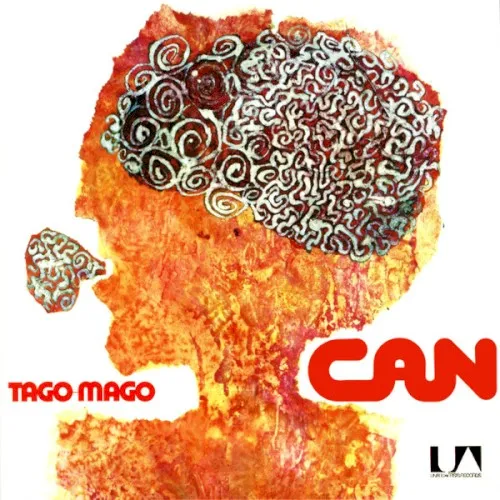
Tago Mago
Can
Tago Mago teaches the listener to trust repetition, then uses editing, spatial change, and vocal disruption to make that trust unstable across its two records.
AI-assisted, human-reviewed
The groove earns the right to become strange
Tago Mago does not begin by asking the listener to admire difficulty. “Paperhouse” opens with guitar chords that leave air between them, Damo Suzuki singing in a low, unforced register, and a band that seems willing to wait. When Jaki Liebezeit tightens the pulse, the change feels less like a new section than a floor sliding into place beneath the same room. Michael Karoli’s guitar grows harsher, Holger Czukay’s bass becomes more insistent, and the performance accelerates without losing its center.
That sequence states the double album’s method. Can gives repetition enough authority to feel dependable, then changes what that repetition can hold. A fixed drum figure may carry calm guitar, vocal alarm, or tape disturbance without announcing a formal transition. Conversely, when the pulse disappears on the second record, every isolated sound inherits the tension built by the first.
“Paperhouse”: acceleration preserves the room
The track’s faster passages do not replace its opening idea. Karoli keeps returning to short, high guitar shapes while Suzuki moves from murmur toward strain. Liebezeit supplies continuity by changing intensity more than outline: the beat becomes urgent, but its clean placement prevents the ensemble from turning into a blur. The result is motion without a conventional verse-to-chorus payoff. Can can travel because each player remembers the shared space.
“Oh Yeah” makes the bargain less comfortable. A backwards vocal enters as an event with no plain semantic foothold, yet bass and drums continue to behave as if nothing has broken. The rhythm does not explain the tape effect. It lets the unexplained sound stay in the piece long enough to become normal.
The castle forces the band into one room
Can recorded at Schloss Nörvenich with a minimal setup built around two stereo tape machines. There was little room for the later repair and separation that multitrack recording encourages. Balance had to be made during performance; Czukay played bass while also handling engineering and later edits. The apparent looseness of Tago Mago therefore rests on severe listening discipline.
Those limits complicate the album’s familiar oppositions: rock against avant-garde composition, groove against noise, improvisation against editing. The sound does not support such clean borders. Liebezeit can repeat a compact figure with mechanical steadiness while changing the pressure of individual hits. Czukay can make a bass pattern feel inevitable, then use tape to reshape the performance that produced it. Irmin Schmidt’s keyboards can supply sustained color or become an abrasive object. Each role stays mobile.
“Mushroom”: restraint makes the eruption larger
“Mushroom” is among the album’s shortest pieces, but it contains its widest dynamic shock. Liebezeit begins with a spare pattern whose kick, snare, and small cymbal details seem to occupy separate depths. Bass and organ avoid filling the gaps. Suzuki’s vocal line hangs over that empty middle until the band strikes a louder refrain, with guitar and voice suddenly pressed to the front.
The quiet returns without feeling restored. Once the eruption has happened, the same sparse beat carries an afterimage of it. This is Can’s economy at its sharpest: no extended development is needed because a change in density alters every repetition that follows.
Halleluhwah turns repetition into direction
The first record culminates in more than eighteen minutes built around limited harmonic movement. “Halleluhwah” could have become a test of endurance. Instead, it keeps changing the listener’s position inside the groove. Czukay’s bass and Liebezeit’s drums establish a cycle firm enough that guitar, electric violin, keyboards, and Suzuki’s broken phrases can enter without resetting the piece.
“Halleluhwah”: the fixed beat keeps acquiring history
Liebezeit rarely uses a fill to announce that something important is about to happen. His pattern remains the important thing. Karoli’s violin scratches across it; guitar figures arrive as brief arguments; the vocal drifts in and out of focus. Tape edits condense a much longer process, but they preserve the sense that the band has been inhabiting one stretch of time rather than assembling a medley.
Because the pulse does not chase each new sound, those sounds become layers of memory. After ten minutes, a return to a leaner texture is not a return to the beginning. The beat now carries everything that has crossed it. Repetition produces direction without needing a destination.
The second record removes the floor
If Tago Mago ended after “Halleluhwah,” it would still be a radical groove record. The second LP refuses that satisfying identity. “Aumgn” stretches voice, organ, percussion, and room tone across a field with no stable rhythm. Sounds approach slowly, change size, and recede before their source becomes certain. The editing no longer hides inside forward motion; it becomes the environment.
“Aumgn”: space replaces the pulse
Schmidt’s elongated vocal sound acts less like a lyric than a measure of distance. Its echo makes the castle audible as an unstable volume, while electronic tones and incidental noises resist the scale of a rock band. Late percussion creates momentum, but it does not resolve the preceding drift. It feels like an intrusion from another performance.
“Peking O” is more crowded and less patient. Suzuki’s clipped syllables collide with stuttering electronic rhythm, abrupt edits, and noises that appear almost comic before turning hostile through repetition. Where “Aumgn” makes time expand, “Peking O” chops it into pieces too short to settle. The album is testing whether its collective identity can survive after the shared pulse has been dismantled.
Sprawl becomes both method and limit
The double-album form allows Can to make a strong structural claim: the groove and its destruction belong to the same practice. The first record demonstrates how much freedom a reliable cycle can contain. The second asks what remains when reliability itself becomes suspicious. Neither half is complete without the other.
That design does not make every duration equally productive. “Aumgn” sharpens attention by denying easy markers, but there are stretches where another slow transformation confirms an atmosphere already established. “Peking O” can feel less open than the grooves it rejects; its density sometimes traps the listener outside rather than changing the terms of entry. The record’s refusal to edit itself into a friendlier shape is principled, but principle and momentum do not always coincide.
Suzuki’s voice creates a related tension. His phonetic English, sudden cries, and melodic fragments free the music from literal narration. They also leave the emotional argument dependent on timbre and placement. On “Paperhouse” that ambiguity deepens the performance. Across the longer abstractions, it can reduce the singer to one more volatile material in the mix.
Coffee arrives, but certainty does not
“Bring Me Coffee or Tea” restores a recognizable pulse, a soft guitar figure, and a vocal that seems almost intimate. After the second record’s severed sounds, the arrangement can initially register as relief. Yet the band does not rebuild the hard rhythmic confidence of “Halleluhwah.” The groove sways, Karoli’s lines keep their distance, and the harmony feels suspended rather than settled.
That modest ending clarifies the album’s achievement. Tago Mago is not a journey from order into chaos with a neat return home. It changes what order means. Live balance, repeated figures, room sound, and razor-blade edits all become ways of deciding which relationships the listener can trust. By the final track, a steady beat is no longer a guarantee of safety. It is one more choice the band can expose, disturb, and briefly make convincing again.
Strengths and limits
Strengths
- Repeated figures keep changing function through touch, density, and editing.
- The studio treatment grows out of ensemble playing instead of decorating it.
Limits
- The second record's long abstractions can exhaust the attention they sharpen.
- Damo Suzuki's voice sometimes works more as texture than as a readable perspective.
Further reading: Irmin Schmidt discusses Mushroom and Can's collective method
Sources
- Tago Mago official album page, credits, and track listing, Can. Accessed August 20, 2026.
- Tago Mago 40th Anniversary Edition press release, Spoon Records and Mute. Accessed August 20, 2026.
- Tago Mago release group and editions, MusicBrainz. Accessed August 20, 2026.
- Forgotten Heroes: Can, Premier Guitar. Accessed August 20, 2026.
- Can: Tago Mago 40th Anniversary Edition album review, Pitchfork. Accessed August 20, 2026.
Album artwork remains the property of its respective rights holders. It is reproduced at limited resolution on this review page for identification and critical context.