 Reviews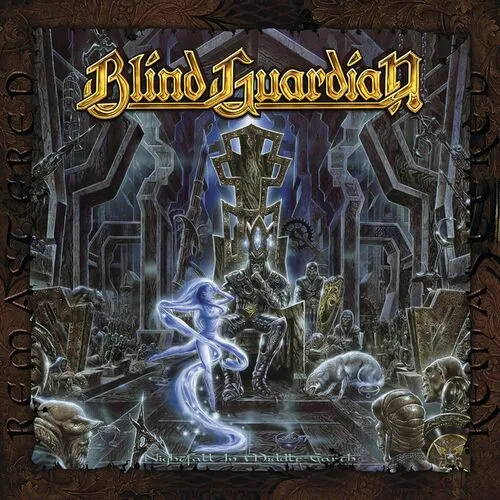
Full Review
AI-assisted, human-reviewed
Nightfall in Middle-Earth
Blind Guardian
Nightfall in Middle-Earth succeeds because its speed and massed voices never offer uncomplicated victory; each anthem carries the pride, grief, or blindness that will undo its characters.
Tragedy before triumph
Nightfall in Middle-Earth opens with voices arguing over an irreversible decision. “War of Wrath” offers no riff and no stable narrator, only accusation, denial, and a door closing. “Into the Storm” then arrives at full speed. The shift is important: Blind Guardian lets the listener feel the exhilaration of action after already revealing that the action is ruinous.
That tension runs through the album. Its choruses are large enough for a crowd, yet Hansi Kürsch rarely sings from a morally secure position. He becomes Fëanor in the grip of his oath, the Noldor crossing into exile, and survivors trying to understand what pride has cost. Multitracked voices enlarge those characters without cleaning them up. A choir can sound like a people speaking together, an argument inside one mind, or history passing judgment.
Blind Guardian selects the theft of the Silmarils, the oath of Fëanor, the flight of the Noldor, and the war against Morgoth as parts of one long fall. The record carries names and battles through that line of cause and consequence. Heroic speed remains available, but innocence does not.
Twenty-two scenes in a continuous fall
The original album contains twenty-two tracks, although only eleven are full songs. Spoken exchanges, acoustic miniatures, and brief sound scenes occupy the remaining positions. On paper that can look like excessive scaffolding. In sequence it gives the record cuts, pauses, and changes of scale that a continuous hour of layered power metal would lack.
The method also reflects how the album was made. The project was the first built around Blind Guardian’s own Twilight Hall Studios, with Flemming Rasmussen again involved in production. The band could treat the studio as part of the composition. Rhythm guitars are doubled into hard edges, André Olbrich’s leads move above them in compact melodic lines, and Kürsch’s vocal stacks frequently become the largest instrument in the mix. Acoustic guitar, flute, violin, and spoken voices interrupt that mass without belonging to a separate decorative world.
The sequencing moves between public disaster and private response. “Lammoth” reduces a cosmic scream to less than half a minute before “Nightfall” considers the damage. “Captured” turns the capture of Maedhros into a clipped dramatic scene before “Blood Tears” enters his confinement. Later, “The Dark Elf” and “The Eldar” place a small spoken threshold between political tragedy and a bare lament. These links are functional because they change the listener’s posture before the next song begins.
The construction is less successful when an interlude explains an emotional consequence that the surrounding music has already established. A few transitions make the album feel closer to an illustrated synopsis than a drama. The best ones leave pressure in the silence rather than summarizing the plot.
Four songs that carry the story
Nightfall: A chorus that cannot celebrate
“Nightfall” begins with clean guitar and a measured pulse. When the full arrangement arrives, the chorus has the breadth of an anthem, but the melody keeps falling back toward grief. Kürsch stretches the title across the bar while the backing voices answer him, creating a public lament rather than a private ballad.
Drums lift the chorus, guitars brighten its outline, and the vocal mass suggests collective memory. The arrangement grows with the consequences while keeping sorrow inside its scale.
The Curse of Fëanor: Speed trapped inside an oath
The rapid riffing of “The Curse of Fëanor” fits its speaker’s impatience. Thomen Stauch’s drums push forward while the guitars keep tightening the path around Kürsch. His lead does not float above the band; short phrases and hard consonants make the vocal feel caught in the same machinery.
The chorus opens the register, but not the character’s thinking. Layers of Kürsch repeat and reinforce the vow until resolve starts to resemble self-imprisonment. Blind Guardian uses a familiar power-metal acceleration and changes its dramatic meaning. Momentum is the problem the song is describing.
Mirror Mirror: Direct language after a crowded history
“Mirror Mirror” strips the argument to one of the album’s most immediate riffs and choruses. The verse moves with a clipped, almost marching force. The refrain then widens into a line shaped for mass singing. Its economy matters after scenes crowded with names, places, and competing voices.
Its melodic confidence belongs to characters trying to establish a hidden realm while the larger catastrophe continues. The chorus creates a temporary center, and the returning riff shows how hard that center must be defended. Accessibility becomes part of the plot rather than a break from it.
Noldor: Exile slows the machinery
“Noldor (Dead Winter Reigns)” lowers the temperature. Its opening guitar figure leaves space around Kürsch, whose delivery moves from controlled reflection toward accusation. The chorus is broad, but the longer phrases prevent it from landing with the clean finality of “Mirror Mirror.”
This is where the album’s vocal density works best. Backing parts do not merely make the hook larger. They surround the lead with the people implicated in the decision, so an individual confession acquires a collective shadow. When the arrangement gathers force, it sounds less like a new battle than memory becoming impossible to contain.
The force of many voices
Kürsch’s range is the record’s central dramatic resource. A dry, close lead can make a character sound isolated. Doubles add resolve or panic. Full choirs turn a decision into history. Because those layers change function from song to song, the album’s vocal scale rarely feels like ornament alone.
The rhythm section also keeps the arrangements from dissolving into pageantry. Stauch can move from fast double-kick drive to a steadier martial pulse without making either feel generic. Kürsch’s bass supports the guitar mass while retaining enough attack to mark changes. Olbrich and Marcus Siepen divide lead motion and rhythm weight cleanly, which allows dense songs to remain legible.
The adaptation works through selection. It follows a particular chain of choices and consequences rather than turning every episode of Tolkien’s book into a song. The recurring subjects of oath, exile, and memory give the album coherence even when a listener cannot place every name.
When density blurs the drama
The same production language returns so often that separate scenes can share one emotional ceiling. Layered choruses, climbing lead guitar, and hard rhythmic acceleration are effective, but by “When Sorrow Sang” the ear knows how grandeur will be assembled. Individual songs remain strong while the complete sequence occasionally loses contrast.
The spoken links are similarly uneven. “War of Wrath” and “Face the Truth” sharpen the argument by staging disagreement. Other passages mainly move pieces on the narrative board. Their brevity prevents serious drag, yet they can make a second listen feel more managed than the songs require.
The album’s literary fidelity reaches a practical limit. Its emotional line is clearer than its exact plot. Listeners without prior knowledge can follow pride, betrayal, exile, and grief, but several changes of speaker depend on the booklet or the source text. The music carries the tragedy more consistently than it carries the genealogy.
The oath outlives the victory
Nightfall in Middle-Earth makes spectacle answerable to consequence. Its fastest songs do not escape the argument established in the opening minute, and its largest choirs keep returning as witnesses rather than decorations. The album can overstate a transition and crowd distinct scenes into the same grand register. It still understands the essential shape of its story: power is gained, songs are raised, and the oath continues to narrow every future choice.
The argument
Strengths and limits
Strengths
- Layered lead and choral voices turn exposition into competing points of view.
- Short spoken and acoustic passages give the long narrative a legible dramatic pace.
Limits
- Several interludes restate consequences the songs have already made clear.
- Dense vocal and guitar layers can compress distinct scenes into one sustained grandeur.
Documentation
Sources
- Nightfall in Middle-Earth album history, Blind Guardian. Accessed July 26, 2026.
- Nightfall in Middle-Earth release and tracklist, Nuclear Blast. Accessed July 26, 2026.
- Nightfall in Middle-Earth release group and editions, MusicBrainz. Accessed July 26, 2026.
- Blind Guardian official biography, Blind Guardian. Accessed July 26, 2026.
Album artwork remains the property of its respective rights holders. It is reproduced at limited resolution on this review page for identification and critical context.